

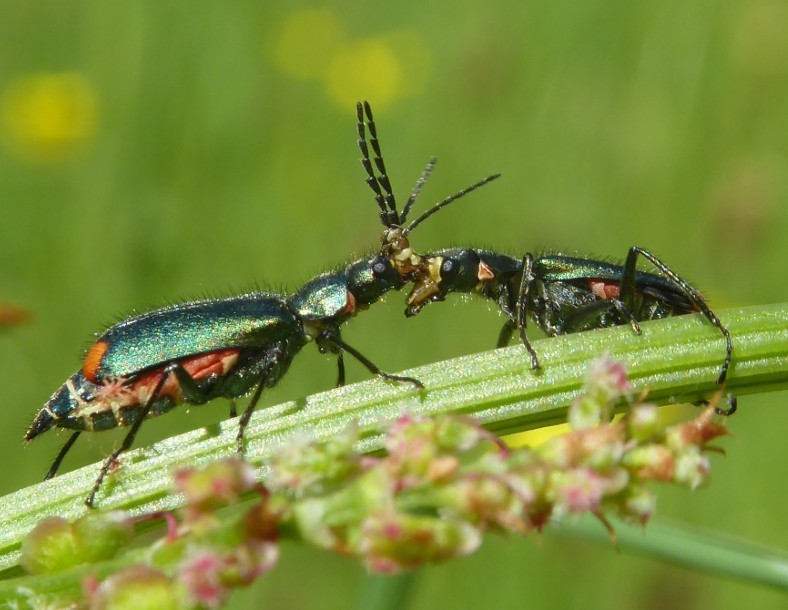
Our churchyards are valued resting places for the dead – but focus on the small things and you’ll find they are also full of life, as Canon Martin Greenland found during his sabbatical this summer when he went on safari in 32 diocesan churchyards in search of insects. Martin is the Rector of Acle & Bure to Yare, as well as an Eco Chaplain and he shares his findings here for all to learn from and to seek to replicate:
I encountered kissing beetles, zombie ladybirds and larvae equipped to fork their excrement onto their backs for protection! I saw both familiar friends, such as the Swollen-thighed Flower Beetle, and recent arrivals, like the Southern Oak Bush Cricket.
Granule-encased caterpillars were grazing lichen on the memorials; hoverflies were laying eggs in aphid colonies; predatory robberflies perched ready to intercept prey; parasitic nomad bees searched for nests of their hosts; and one church tower was being scaled by a hunting-wasp, dragging her spider prey. Some things bright and beautiful; others weird and wonderful: products of evolution, the means by which God’s handiwork (as I see it) continues to unfold.
In the short walk from lychgate to porch we can pass through a microcosm of God’s amazing creation – particularly if the churchyard is managed to encourage the diversity which is clearly the Creator’s intention. Indeed, given the stewardship of creation implied by Genesis, Christians may well feel we have a responsibility to do that on the land surrounding our places of worship: churchyards can be valuable oases for biodiversity in landscapes dominated by less friendly regimes, whether urban hard surfaces or intensive rural food production.
Without trying to break any records, I submitted over 750 records of some 310 insect species – one of them a fly not previously recorded in Britain: little do we know what’s out there waiting to be discovered!
True, there are features (mass mortality, predation, parasitism) we might find disturbing, apparently at odds with God’s nature; but they are an intricate part of the whole. Uncontrolled by native parasites, alien Box Tree Moth caterpillars completely stripped a hedge in my garden, eating themselves out of house and home in the process: underfed caterpillars left the bare hedge in a fruitless search for food.
We can’t set out to separate the weeds from the wheat. Julian of Norwich saw that God loves it all, otherwise it wouldn’t exist; Jesus said his Father doesn’t overlook the fall of one sparrow. Maybe some aspects of Creation in Christ are cross-shaped; but the redeeming outcome is an abundant, interwoven, diversity of life.
I have incorporated many of the photos from my surveys into a presentation (see button link below) with a short caption on each species. There are sections featuring:-
- at least one photograph from each of the 32 churchyards
- some of the different orders of insects: butterflies & moths; crickets & grasshoppers; flies; and beetles;
- some ‘familiar friends’ you might like to look out for; and
- species grouped by their ecology: plant-feeders; predators (including aphid-eaters) and parasites.
It should be possible to do a text search (Ctrl F) to find all the featured photos from a particular churchyard, or a particular insect. I’ve used English names where these are widely accepted; scientific names where not.
I’ve also produced an A4 sheet (below) with my advice on how to encourage insects in a churchyard, supplementing advice from Norfolk Wildlife Trust and others on how to promote floral diversity – which itself benefits a range of insects.