
History of the Garden
This garden has belonged to the Bishops of Norwich for more than 900 years.
Its history stretches back to the earliest days of neighbouring Norwich Cathedral and since 1096 more than 70 bishops have walked its paths, prayed within its walls and shared the fruits of this peaceful, productive place.
The first gardeners were the monks who lived, worked and worshipped at the Cathedral and Benedictine monastery. They grew plants for food and medicine, and flowers chosen for their beauty or fragrance.
The current Bishop of Norwich, the Rt Revd Graham Usher, is a keen gardener. As the Church of England’s lead bishop for the environment, and the international Anglican lead for biodiversity, he uses his garden to offer hospitality as part of his ministry, to grow food and to highlight the wonder of the natural world. The garden hosts retreats, open-air meetings, school visits, open days, art days and an annual garden party for refugees. Last year’s charity open afternoons raised more than £20,000 for local good causes.
“Seeing this beautiful and ancient garden give such pleasure to visitors and being able to share it with so many people to help the work of local charities, is a great privilege,” said Bishop Graham.
In a new tradition, started after the pandemic, the men and women about to be ordained as deacons and priests, take their oaths to king and country, and make their declarations of Christian faith, standing in the garden.
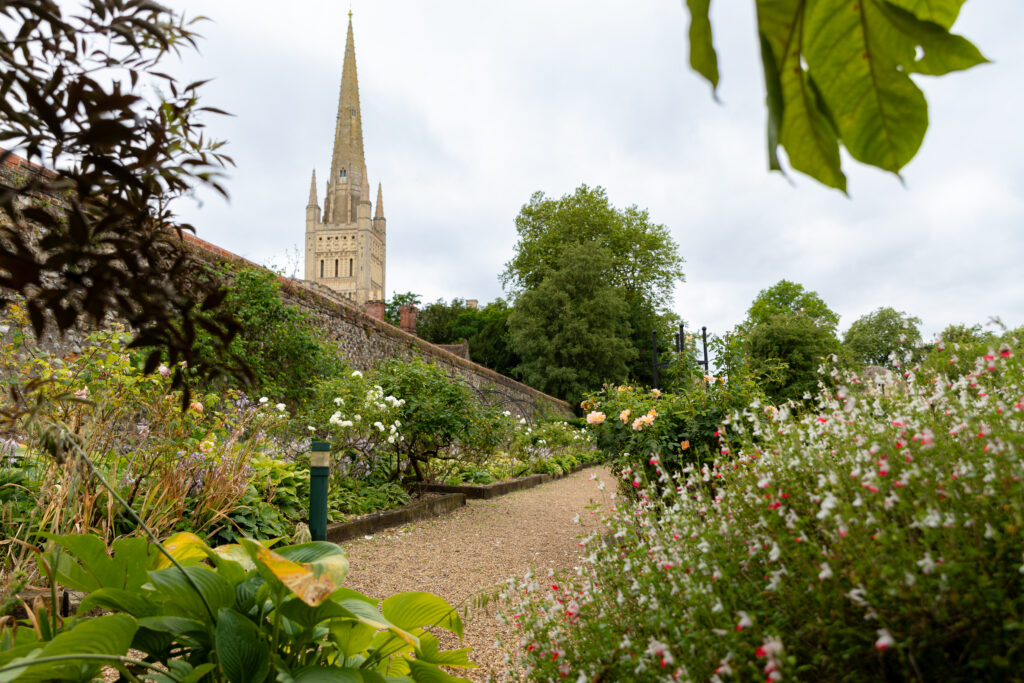
One of the many joys of the garden is that it has the best views of the glorious Norman stonework on the northern side of the cathedral.
The main entrance to the house and garden area is through Bishop Alnwick’s Gate, a tower gatehouse built in the 1400s.
On the top lawn a picturesque 700-year-old ruin known as Bishop Salmon’s Porch is all that remains of a huge medieval hall. The nearby chapel was built in 1662, after the original chapel and great hall of the medieval Bishop’s Palace were demolished. It is now used as a library by Norwich School.
The Old Bishop’s Palace, now also part of Norwich School, was completed in around 1860. The current Bishop’s House was built in 1959.
Charity open days
The Bishop of Norwich and his wife open their garden for local charities on selected spring and summer Sundays as part of Bishop Graham’s ministry.
This year more than 3,200 people enjoyed the open afternoons and helped local charities raise more than £25,000.
Local charities interested in hosting an open garden afternoon can find out how to apply by emailing louise.cumberland@dioceseofnorwich.org
Applications must be received by Wednesday September 30.
The dates for next year’s charity open days will be announced early in 2027.
This year’s charities were Big C, Norfolk Wildlife Trust, the Magdalene Group, Community Chaplaincy Norfolk, the National Garden Scheme, St John Ambulance , Norwich Door to Door and Vision Norfolk.
Bishop’s House Garden will also be open for the 2026 Heritage Open Days on September 16 and 17.
To find out about private group tours of the garden with head gardener Tom Halliburton email louise.cumberland@dioceseofnorwich.org
The gardeners
Tom Halliburton
Head gardener Tom Halliburton loves being part of a line of plant-lovers stretching back more than nine centuries who have cared for this ancient garden. He works hard to ensure the organic garden is a place of peace and calm and particularly enjoys propagating new plants and looking after the many rare species.
Tom studied landscape gardening and garden design at horticultural college before setting up his own gardening business. Now in charge of one of Norfolk’s most historic gardens he welcomes people to charity fund-raising afternoons and pre-booked tours and retreats.
The garden also has a small volunteer group and opportunities for work experience. Tom is keen to expand the friendly and welcoming gardening volunteer group. Anyone interested in joining should email him at head.gardener@dioceseofnorwich.org
Victoria Bleksley
Assistant gardener Vic is passionate about promoting sustainable practices and encouraging bio-diversity. She is interested in the beneficial effects of people’s interactions with plants, gardens and natural environments for well-being and has studied horticulture and social and therapeutic horticulture.