

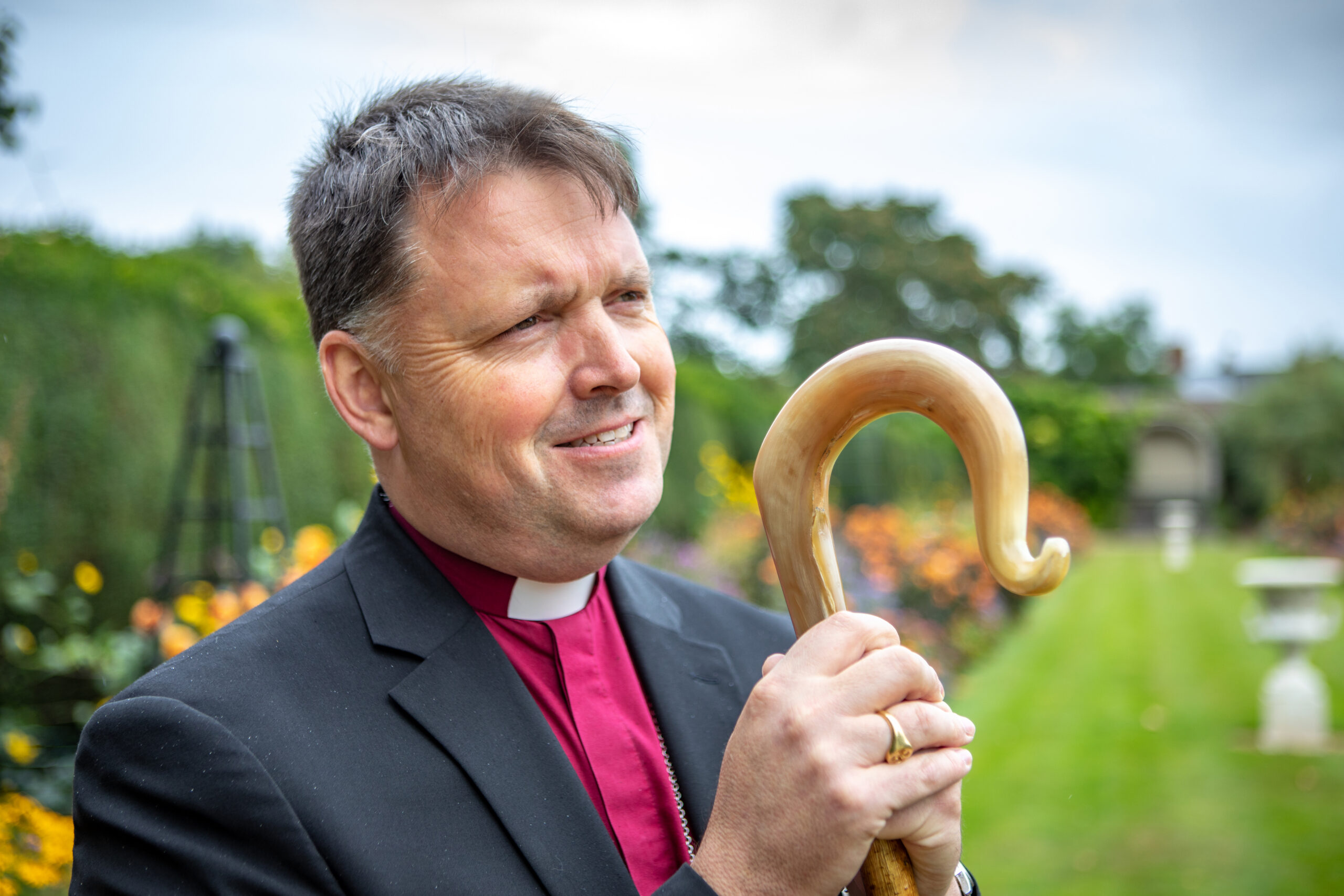
The Bishop of Norwich’s presidential address to Diocesan Synod on Saturday March 21 explored the theme of generosity – of spirit and of wallet.
St Paul said to the early church in Corinth: “You will be enriched in every way for your great generosity, which will produce thanksgiving to God through us; for the rendering of this ministry not only supplies the needs of the saints but also overflows with many thanksgivings to God.” – 2 Corinthians 9:11-12
I would like to spend this Presidential Address reflecting with you on the theme of generosity. There are many types of generosity, but here I would like to focus on two. How we are generous with each other, and how we are generous towards the wider mission of God’s Church. You could say: generosity of spirit and generosity of wallet.
Generosity brings great joy to the giver and the recipient. Recall the face of someone you have given a present to, or offered a kindly word of encouragement, or that spontaneous hug of a child or grandchild. Too often, though, I find generosity can be a virtue that is in short supply or withheld. Recall the quick judgements that we come to about others, or our sweeping conclusions that seeks to cast out the other. Too often in the life of the Church we withhold our generosity – failing to see the face of Christ in one another.
At its heart, generosity is the creation of space for another to be who they are. In the Gospels we see this in the curious freedom that characterises Christ’s encounters with those around him. Those who come to him – tax collectors, strangers, the morally compromised, the physically wounded – discover themselves addressed not as problems to be solved but as persons to be seen.
This recognition is itself a form of gift. To be seen truthfully is to be liberated from the imprisoning narratives that others, or we ourselves, may have imposed upon us. Christ’s generosity lies partly in his refusal to collapse people into their failures or their social identities. He addresses Zacchaeus not primarily as a collaborator with injustice but as a host capable of welcome; he meets the Samaritan woman not as an object of moral scrutiny but as someone capable of receiving living water. The generous act, then, is one that resists reducing another person to a category within our moral accounting. And the generous community is one that isn’t a school of the perfect, but where people, knowing that they mess up and are imperfect, are simply received and join others in seeking to be disciples together encountering the love of God in Jesus.
Then there is the generosity of the wallet that wells out of this generosity of the spirit. I have often found it easier to experience this generosity in the economically poorest communities in this diocese. I recall a visit to St Andrew’s Roman Hill in Lowestoft where tea and toast are offered to local people using a winter warm hub. I’ve also seen generosity at work in rural parishes, who have the challenges of their medieval building but don’t let that define them, such as a confirmation tea at Hillington that was marked with kindness and care and encouragement to the candidates. As an aside, many of our rural churches were built to keep their benefactors our of purgatory – the problem is that we are still paying for that!
And I have discovered generosity in the poorest communities of the Anglican Communion who have materially very little but give abundantly. Those of us who visited our link dioceses in Papua New Guinea back in September experienced that every day of our visit as from their little, people gave their all.
Too often, though, I sense we have a spirit of how little can I get away with financially giving rather than how much can I offer. We speak as if we are a Church of scarcity rather a Church that mirrors and overflows with God’s abundance. We forget that God promises to give us our daily bread. We have failed in our nerve to see the audacious generosity of God at work in our own life, in the life of others, in the life of our community, in the life of God’s Church. The audacious generosity of God at every table breaking bread, every act of forgiveness offered and received, every baptism, marriage and funeral, every hand held, and in the patient slow and difficult work of reconciliation.
Within the Christian imagination generosity is not an appendix to an otherwise self-contained life, but integral to how we are shaped by the life of God. The God revealed in the Gospels is not a solitary possessor of goodness but an eternal movement of giving and receiving: the Father pouring out life to the Son, the Son receiving that life and returning it in love, the Spirit the living circulation of that gift. Generosity is therefore not an optional spiritual habit; it is a small participation in the divine ecology of self-giving.
The scriptural narrative persistently unsettles the human fantasy that what we have is ours. As they say in Yorkshire, there are no pockets in shrouds! The opening chapters of Genesis speak not of possession but of gift: existence itself appearing without negotiation, without merit, spoken into being by a God who delights in what is not yet there. Creation is therefore not simply the backdrop to human moral life; it is the first and most comprehensive sign that reality is grounded in generosity.
The Gospel narratives repeatedly honour those whose generosity emerges precisely from precariousness rather than abundance. The widow who places her small coins in the Temple treasury is not celebrated because her offering solves anyone’s financial problem. Instead, she becomes a sign of a deeper truth: that generosity is measured not by quantity but by the degree to which the act expresses trust in a reality beyond possession. Her gift represents a relinquishing of the protective illusion that life can be secured through what we hold onto.
The same logic is visible in the feeding miracles. What begins as a painfully insufficient offering – a few loaves and fish – becomes, in Jesus’s hands, the source of nourishment for a multitude. When the disciples see limitation, Jesus receives what is present with thanksgiving. Generosity begins precisely at this point of gratitude, where what we have is acknowledged as gift, and is then multiplied.
What, I wonder, would it be like if our giving, both personally and in the payment of parish share, multiplied life? Our parish and diocesan budgets are, in essence, theology in numbers. They say what we treasure most and where our priorities lie. That is why the largest item on the DBF’s budget is the deployment of clergy. As a parish priest in one of the toughest parts of Middlesbrough, now a ward with one of the highest percentages of child poverty in England, I was always moved that the churchwardens saw, and took immense pride in, the parish share being the first entry of the PCC’s budget. There was a sense of real commitment to it. I know many of you share that commitment and I want to say a resounding ‘thank you’ to you.
If we could speak more openly about responding to the generosity of giving in our parishes and chaplaincies, then perhaps our average weekly gift in this diocese of £11.21, the second lowest in the Church of England, might rise to meet or exceed the national average weekly gift of £14.70. We are far, far from being the economically poorest population. Interestingly, those parishes who are using the Parish Giving Scheme had a weekly average gift of £16.25 over the last 10 months. If you are not doing it yet, it makes a big difference.
It is our shared task as Diocesan Synod to do all we can, as those who approve the DBF budget each year, to increase parish share payments received upwards from the 79.6% last year. If we can do that together, then we will be able to do so much more to see our parishes revitalised for mission and more lives transformed by Christ. We are all in this together. I hope you will commit to doing that with me. And bring that commitment to every discussion of parish share in our parishes, benefices and deaneries.
There are a plethora of helpful resources from the Generous Giving Team – the new video explaining parish share, the Cornerstone web resources, the Parish Giving Scheme. Let’s ask ourselves: When did your church last run a stewardship campaign? How might we reach those on the fringe, or those in the wider community who want a local church? Do you have information available about making a legacy gift? And, just as an aside, the parish share request is not an upper limit – for some parishes generosity might extend beyond that so as to be a blessing to others within a benefice, or elsewhere in the diocese.
At the heart of Christian worship lies a gesture that gathers these themes together. The Eucharist begins with the taking of bread and wine – ordinary elements of human labour and the earth’s fruitfulness. They are blessed, broken and shared. In this simple pattern we glimpse the grammar of divine generosity. What is received with thanksgiving becomes capable of nourishing many. The bread that is broken recalls a body given up; the cup evokes a life poured out – recalling the frequent costliness of generosity.
To live generously is to inhabit the world eucharistically. It is to recognise that everything we receive – time, relationships, abilities, money, the stuff around us – arrives first as gift. When these gifts have the potential to become part of a larger circulation of grace, overflowing with many thanksgivings to God, they mirror the life of the God whose abundance is never exhausted. I invite you to mirror that generosity, in both our generosity of spirit and generosity of wallet, as we share our life together as the people of God serving the parishes and chaplaincies of this diocese.