Alan Bennett’s film The Choral has just been playing in the cinemas. Set in 1916 in a Yorkshire mill town, it explores how a local choral society responds when so many of its male members have gone off to fight in the Great War. Conscription, national duty, patriotism are all explored as the choir reject German composers’ works and choose to sing Elgar’s The Dream of Gerontius, a deeply emotional and spiritual piece. Grief, loss and hope meet as the community re-finds its singing voice, interrupted by the arrival of a pompous and arrogant Edward Elgar. The film reminds us that there is a more profound form of patriotism than a superficial pride in a land of hope and glory – one built on a shared suffering, collective memory, and redemption.
We have seen more and more on our streets what is, to me, a frightening form of so-called patriotism from those who wave the St George’s cross to provoke, intimidate, create fear, and stake territory; ways that such a cross-imbued flag should never be made to represent. When this has happened, for example in Diss and at Bowthorpe in recent months, with some saying they are upholding Christian values, I’ve asked myself, “Do angry flag wavers look like Jesus, or do they look more like those who jeered at him on the way to Calvary?”
Faithful patriotism is different. It starts with the recognition that God comes first – before any flag. It is about a humility of presence. It seeks to convene rather than divide. It recognizes the cracks in our nation and our society and seeks to mend them. It refuses to scapegoat. It is committed for the long haul. It seeks honesty, repentance and renewal because no country is perfect; every flag flies over both good and bad histories.
Welcoming those from other places has long been part of our national story. Indeed, let’s not forget that we changed our patron saint so that we would have a foreigner! Born in Cappadocia, now modern-day Turkey, to a Palestinian mother and a father of Syrian heritage, Saint George served as a Roman soldier and was martyred for his Christian faith under one of Emperor Diocletian’s persecutions. Now here is the surprise for some: he never set foot in England! George replaced Saint Edmund as our patron saint largely because he was championed by Richard the Lionheart who during his reign lived mostly in France, barely visited England, and didn’t even speak a word of English!
We are witnessing a growing movement of the Far Right and Christian Nationalism that has strong doses of racism, xenophobia, antisemitism and Islamophobia hard-wired into it. Though not everyone involved in protests and flag waving belong to these groups, or are racist, xenophobic, antisemitic or Islamophobic, my fear is that more people will be seduced by those evils because they offer easy answers to complex challenges.
That is not to diminish that many people understandably have concerns about the numbers of those seeking asylum in the UK, have concerns if there is accommodation for migrants in their community, have concerns about young men bored and aimless walking their streets, and have concerns when there are local crimes, including sexual violence. The danger is that we can so quickly scapegoat and stereotype, lumping others together. This results in fear spreading within settled long-standing minority ethnic communities, overseas students here to study, and those on work visas fulfilling vital roles in healthcare, agriculture and other industries where we need these skills. Fear stokes fear.
I believe that we need a good, evidence-based debate on this subject. Within that, we also need to see the humanity of each person. Too often asylum seekers are being blamed for wider systemic problems we face as a nation, because that is the easy thing to do, rather than fixing issues of work, housing, access to health care, poverty, family breakdown and social fragmentation, uprootedness and integration – a mix of genuine moral and material needs.
Our local and national political leaders need to foster open and honest conversations that will bring our communities and nation together. Often, we as churches do that well locally, including working ecumenically and through interfaith projects. Rarely do I visit a church in our urban areas, and often in rural communities, that has not welcomed and integrated refugees. I have met individuals and families who have experienced oppression, torture, violence and war. Their stories are powerful and moving. They have fled their homelands in utter fear and found a welcome in Norfolk, rebuilding shattered lives and integrating well, often with the support of kind- and open-hearted local Christians who are living out God’s commands to love the stranger (Leviticus 19:33-34).
Norwich and Norfolk has a long tradition of welcoming the stranger. One of the most joyous afternoons for me is each July when we have a garden party at Bishop’s House specifically for refugees. Many of the 300 or so people who come bring food to share, and I provide that exquisite British delicacy – a Mr Whippy’s ice cream van dispensing 99s to everyone!
Among them is Mahmood who anointed me with the oil of chrism at my installation in the Cathedral to remind me of my baptism; one baptised Christian to another. Mahmood was forced to become a refugee because he was found with a copy of St John’s Gospel and narrowly escaped execution. He decided to follow in the footsteps of the one who was made a refugee as an infant fleeing the despotic Herod, and who had nowhere to lay his head.
Christ’s enemies are not people groups or nations; they are sin, death, the powers of darkness, injustice, and rebellion against God. Christ’s reign is redemptive: he defeats the forces that dehumanize and divide humanity. In his Kingship, God’s vision finds fulfilment as all things are united in him; God continually seeks to knit people together; to continually cross the borders we seek to draw, “so that”, as Saint Paul writes, “God may be all in all” (1 Corinthians 15.28). His kingdom includes people “from every nation, from all tribes and peoples and languages” (Revelation 7.9).
No nation has a monopoly on Christ; no flag owns him.
It is in his Kingdom where we find our primary citizenship and where we find our true identity as Christians. Nations rise, nations fall, but the Kingdom of God is unshakeable. And the security of that home enables us to provide a wide tent of welcome, working across denominations, working with other faith communities and people of goodwill to build life together well; still to be trusted as convenors and curators of community. I think that’s why, when I was bishop of Dudley, members of the Muslim community so movingly called me ‘our bishop’.
It is within the societal challenges that I’ve described, not some sealed bubble, that the Church lives and breathes and serves. It does so also in an increasingly anxious time for world peace, and a remaking of the world order we could hardly have imagined 5 years ago, with war a frightening possibility. It does so in a time of environmental crisis with climate change, biodiversity loss and pollution impacting many peoples’ lives, fuelling scarcity of resources, conflict, war and migration. It does so amidst creaking public services and when inequality is widening between the haves and the have nots. To be concerned about these things is to seek to respond to the reality of our situation and to find life in all its abundance for all.
I find that I can begin to trace answers to all of this in being transformed by Christ by a prayerful, pastoral and prophetic life as part of the family of the Church. I believe that to follow in the way of Jesus Christ is the best decision that anyone can make in their life. Christian discipleship is living in the shadow of Jesus, trusting him, hearing him say to each of us, “Do not be afraid”. Churches can so often be islands of coherence in an ever widening and deepening sea of chaos. Bishop George Bell said at the start of the chaos of the Second World War, in words that speak to our age too, “It is the function of the Church at all costs to remain the Church.” (Bell, G. K. A. 1939 The Church’s Function in Wartime).
That is why the diocesan vision and strategy work is so important; why I dream that we foster a missional culture in every place, served by hope-filled clergy and lay leaders, deepening our commitment to discipleship so that more of our churches are thriving, as well as growing including growing younger and more diverse.
We need the courage to do this. Courage to hope, and courage to act.
When we do, we will contribute something of great value to our local and national community as more people witness to the transformed, redeemed life found in Christ. That will also claim back the St George’s cross as a sign not of superiority, but of sacrifice; not a claim of ownership, but an offering of self-giving love. A sign that symbolises the Kingdom of God which is in our midst whenever we pursue peace, practice justice, reject racism, and show hospitality to the outsider by loving our neighbour.
Thus, when the flag of St George flies over anger, the Church continues to fly it from our towers in prayer.
When the flag of St George flies over clenched fists, the Church continues to fly it over our open hands feeding the hungry, welcoming the stranger, visiting the sick, and tending the earth.
When the flag of St George flies over placards that speak of defending Christian values, the Church continues to fly it as a reminder that St Paul teaches us that those values are “love, joy, peace, patience, kindness and goodness” (Galatians 5.22).
Friends, this is the way of Christ, the slow building of a land of God’s Hope and Glory. It is that vision for the people and places of this diocese that I invite you to be part.
Written by the Bishop of Norwich, the Rt Revd Graham Usher, November 2025
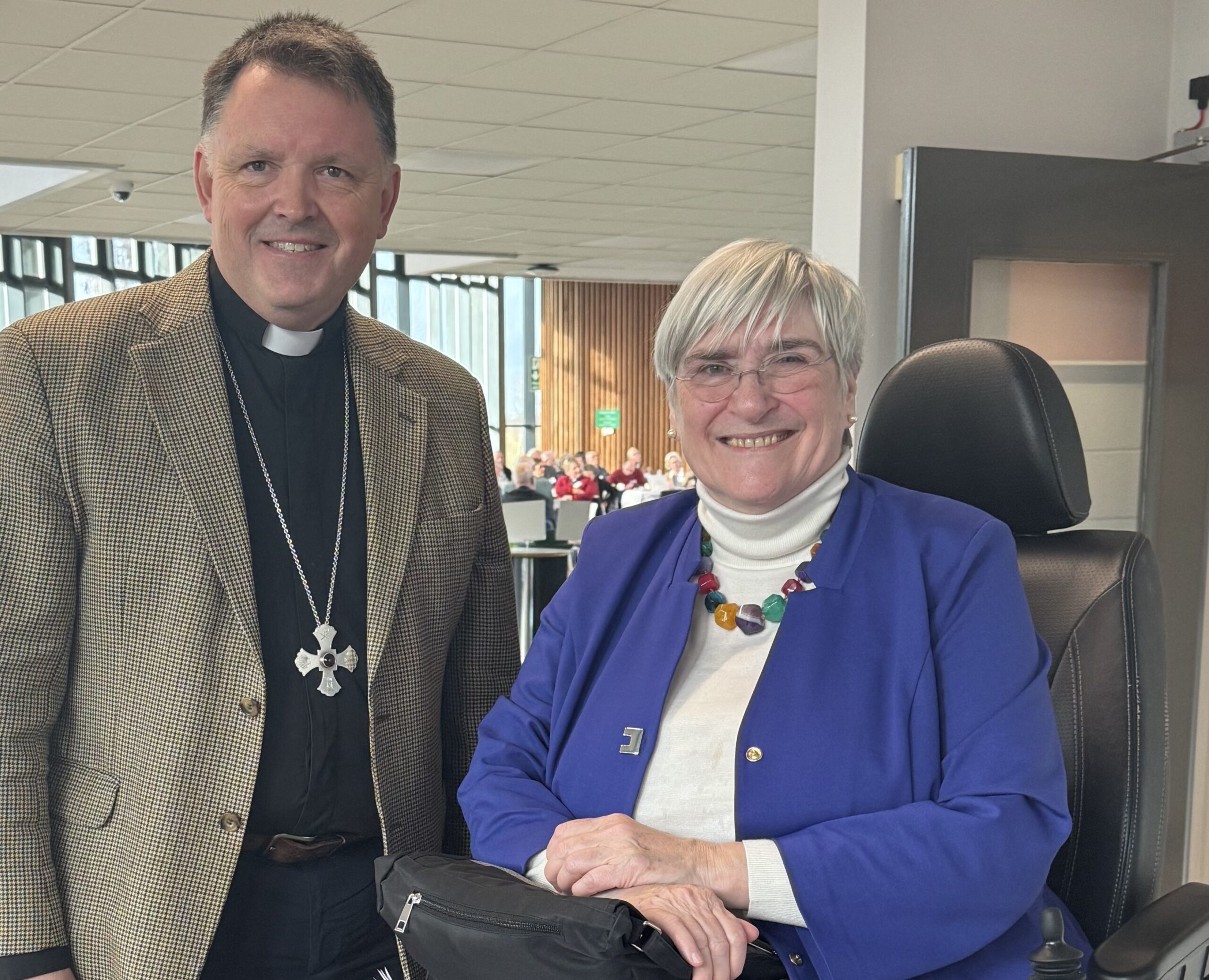
(Image: The Bishop of Norwich, the Rt Revd Graham Usher with Baroness Sal Brinton)