

Garden charity open days 2026
The Bishop of Norwich and his wife open their garden for local charities on selected spring and summer Sundays as part of Bishop Graham’s ministry.
The garden is open on
Sunday May 10 for Big C – improving the lives of people affected by cancer.
Sunday May 17 for Norfolk Wildlife Trust – celebrating 100 years of protecting and restoring wildlife.
Sunday May 31 for the Magdalene Group – working to end sexual violence, exploitation and coercion.
Sunday June 21 for Community Chaplaincy Norfolk – trains and supports volunteer mentors for prison leavers.
Sunday July 5 for the National Garden Scheme – funding nursing and health charities.
Sunday July 12 for St John Ambulance – first aid charity.
Sunday July 19 for Norwich Door to Door – community transport for people with limited mobility.
Sunday July 26 for Vision Norfolk – supporting people through sight loss.
Last year 3,000 people visited the garden for the charity open afternoons, raising more than £20,000 for local good causes.
The garden will also be open for Heritage Open Days on September 16 and 17.
Information for open afternoons
Open 1-4.30pm (last entry 4pm) with refreshments, plant sales and more.
Admission £5, FREE for children and wheelchair-users. Assistance dogs only.
Bishop’s Garden, Norwich, NR3 1SB.
To book private group tours of the garden with head gardener Tom Halliburton, contact the Bishop’s finance and facilities assistant by emailing louise.cumberland@dioceseofnorwich.org
History of the Garden
This garden has belonged to the Bishops of Norwich for more than 900 years.
Its history stretches back to the earliest days of neighbouring Norwich Cathedral and since 1096 more than 70 bishops have walked its paths, prayed within its walls and shared the fruits of this peaceful, productive place.
The first gardeners were the monks who lived, worked and worshipped at the Cathedral and Benedictine monastery. They grew plants for food and medicine, and flowers chosen for their beauty or fragrance.
The current Bishop of Norwich, the Rt Revd Graham Usher, is a keen gardener. As the Church of England’s lead bishop for the environment, and the international Anglican lead for biodiversity, he uses his garden to offer hospitality as part of his ministry, to grow food and to highlight the wonder of the natural world. The garden hosts retreats, open-air meetings, school visits, open days, art days and an annual garden party for refugees. Last year’s charity open afternoons raised more than £20,000 for local good causes.
“Seeing this beautiful and ancient garden give such pleasure to visitors and being able to share it with so many people to help the work of local charities, is a great privilege,” said Bishop Graham.
In a new tradition, started after the pandemic, the men and women about to be ordained as deacons and priests, take their oaths to king and country, and make their declarations of Christian faith, standing in the garden.
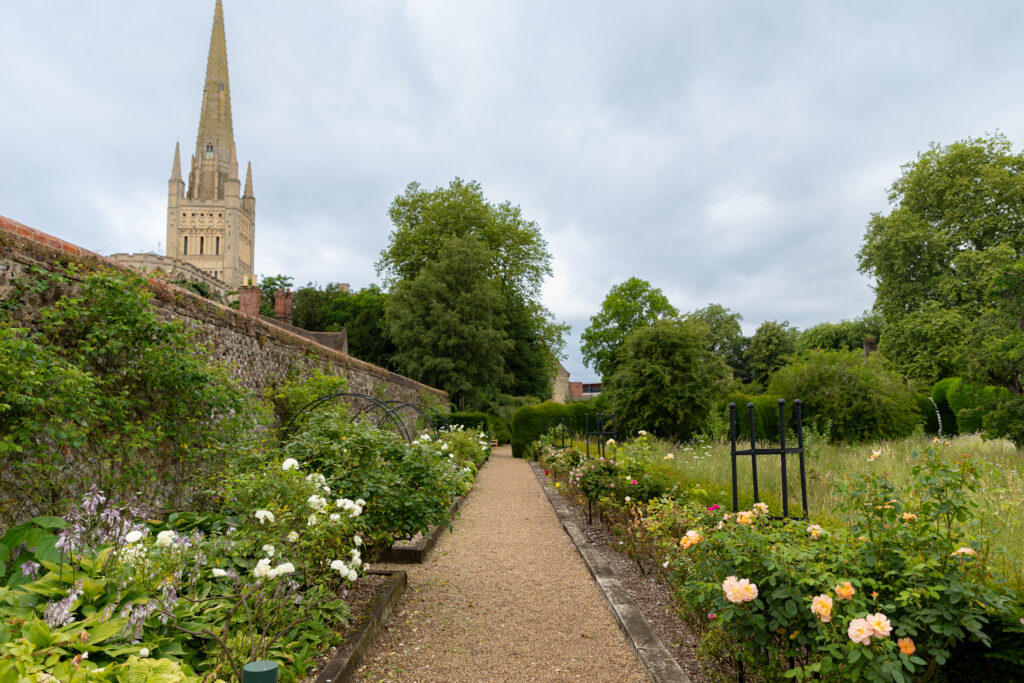
One of the many joys of the garden is that it has the best views of the glorious Norman stonework on the northern side of the cathedral.
The main entrance to the house and garden area is through Bishop Alnwick’s Gate, a tower gatehouse built in the 1400s.
On the top lawn a picturesque 700-year-old ruin known as Bishop Salmon’s Porch is all that remains of a huge medieval hall. The nearby chapel was built in 1662, after the original chapel and great hall of the medieval Bishop’s Palace were demolished. It is now used as a library by Norwich School.
The Old Bishop’s Palace, now also part of Norwich School, was completed in around 1860. The current Bishop’s House was built in 1959.
Some of the plants
Almost every plant has a purpose and a story in the oldest private garden in Norwich.
Its four acres include magnificent herbaceous borders, backed by cloud-pruned English yew probably planted at least 200 years ago. Plants here include stately globe artichoke (Cynara carduculus) and blue globe thistle (echinops bannaticus), plus persicaria polymorpha, rudbeckia laciniata and alstroemeria ‘Indian Summer’ or Peruvian lily.
The kitchen garden is one of the great glories of Bishop’s House Garden. With soil nourished by the garden’s own organic compost it yields magnificent crops including beans, broccoli, cabbage, cauliflower, potatoes, parsnips, aubergines and squashes. Soft fruits thrive in cages surrounded by sweet peas, sunflowers, and dahlias which splash jewel colours across the beds into November.
The bishop is a beekeeper and his bees forage from hives set in an orchard and wildflower labyrinth, with a 400-year-old pear tree at its heart. A newly-planted section of the orchard is part of the Queen’s Green Canopy, celebrating Queen Elizabeth’s 2022 Platinum Jubilee.
Pyramidal, early purple and bee orchids appeared in the garden after mowing was reduced in some areas.
The garden is surrounded by 700-year-old walls. They shelter the tender plants of the jungle walk. Banana (Musa basjoo), tree fern (Dicksonia antarctica), rice paper tree (Tetropanax rex) and Mexican fan palm (Washingtonia robusta) grow here – some a legacy from Will Giles’ famous Exotic Garden.
The white garden is tucked into a corner of the old walls. An unusual white wisteria and a white passionflower are part of an area begun by the last bishop and his wife in memory of the baby daughter they lost to cot-death.
Nearby a catalpa tree spreads its branches over a hidden high-hedged dell, ideal for quiet prayer or contemplation.
The herb garden has been recently redesigned and replanted with a focus on medicinal herbs. Fennel, sage, lemon balm, echinacea, blessed milk thistle, angelica archangelica, valerian and woad are just some of the plants which billow over new metal edging.
On the top lawn Bishop Graham planted a glade of silver birch planted as a sign of hope amidst the pandemic. There is also a mulberry tree thought to be more than 400 years old, one of the biggest tulip trees (Liriodendron tulipifera) in Norfolk, planted in 1850, and two London Plane (Platanus hispanica), also planted in 1850 and among the largest in Norfolk.
A hebe grown from a sprig taken from Queen Victoria’s wedding bouquet in 1840 thrives in a sheltered border – cuttings have been given to the late Queen Elizabeth II and Diana, Princess of Wales, and His Majesty The King.
Every spring masses of purple wisteria flowers arch over a seat set into a bower by the walls.
One bishop had a particular interest in bamboo and the garden includes a fernery and bambooserie.
A prettily scented rose and hosta walk runs along part of the south wall and beyond the herb garden the formal path merges into a meandering woodland walk, towards a gate leading to the Bishop’s door into the cathedral.
A century ago 15 gardeners worked here. By the 1950s there were nine and today the garden is looked after by one full-time and one part-time gardener, plus the Bishop of Norwich and a group of dedicated volunteers who give their time and skill to this city centre sanctuary.

The gardeners
Tom Halliburton
Head gardener Tom Halliburton loves being part of a line of plant-lovers stretching back more than nine centuries who have cared for this ancient garden. He works hard to ensure the organic garden is a place of peace and calm and particularly enjoys propagating new plants and looking after the many rare species.
Tom studied landscape gardening and garden design at horticultural college before setting up his own gardening business. Now in charge of one of Norfolk’s most historic gardens he welcomes people to charity fund-raising afternoons and pre-booked tours and retreats.
The garden also has a small volunteer group and opportunities for work experience. Tom is keen to expand the friendly and welcoming gardening volunteer group. Anyone interested in joining should email him at head.gardener@dioceseofnorwich.org
Victoria Bleksley
Assistant gardener Vic is passionate about promoting sustainable practices and encouraging bio-diversity. She is interested in the beneficial effects of people’s interactions with plants, gardens and natural environments for well-being and has studied horticulture and social and therapeutic horticulture.