

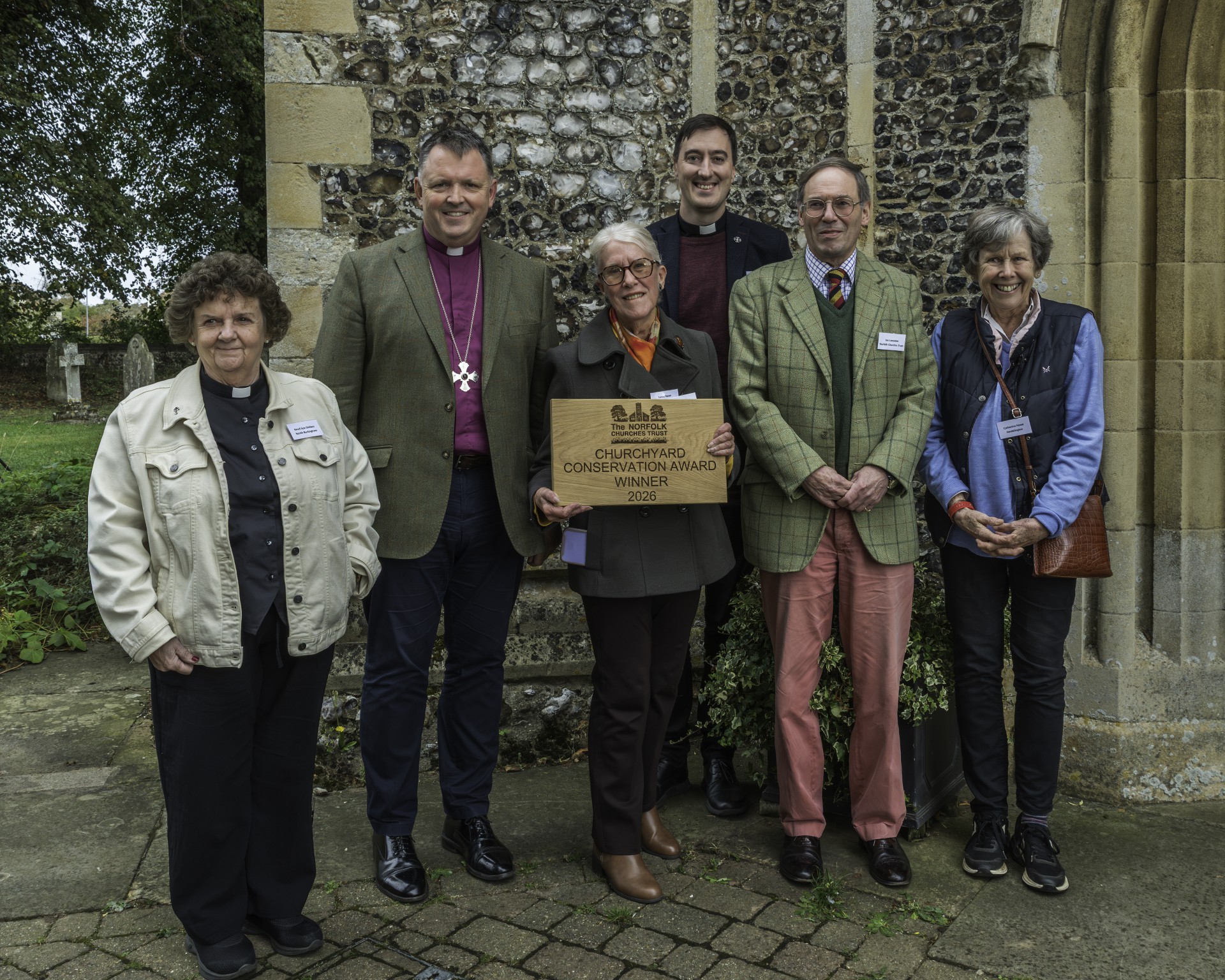
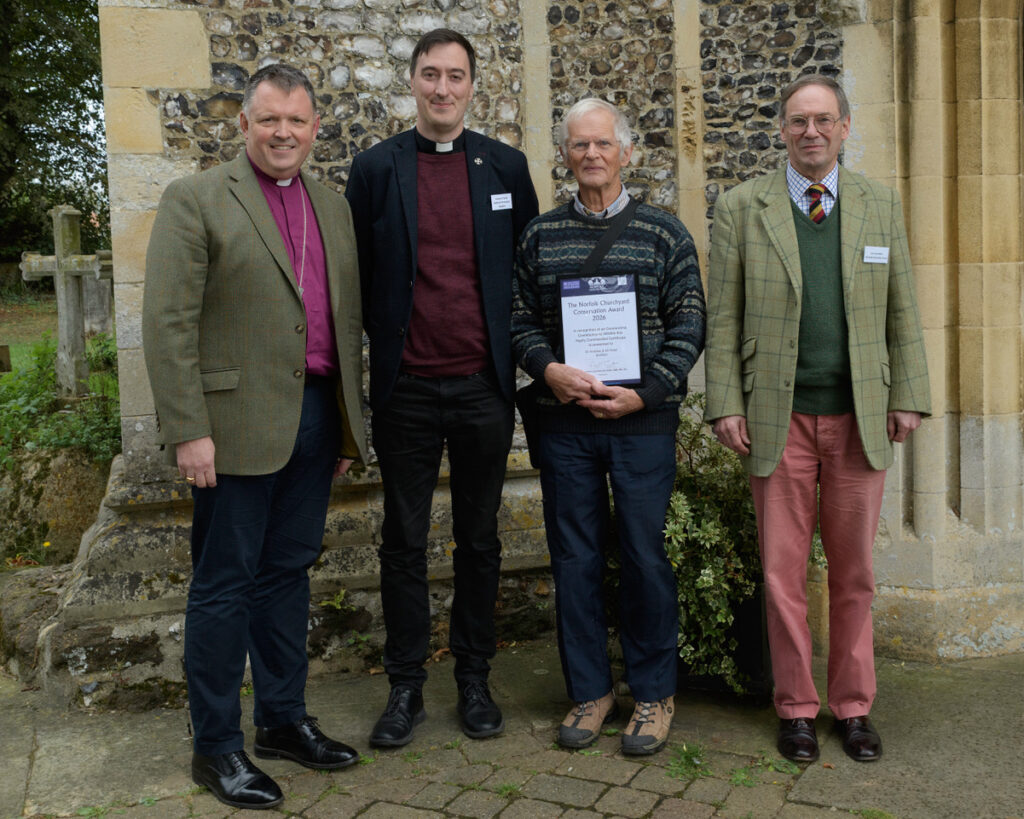
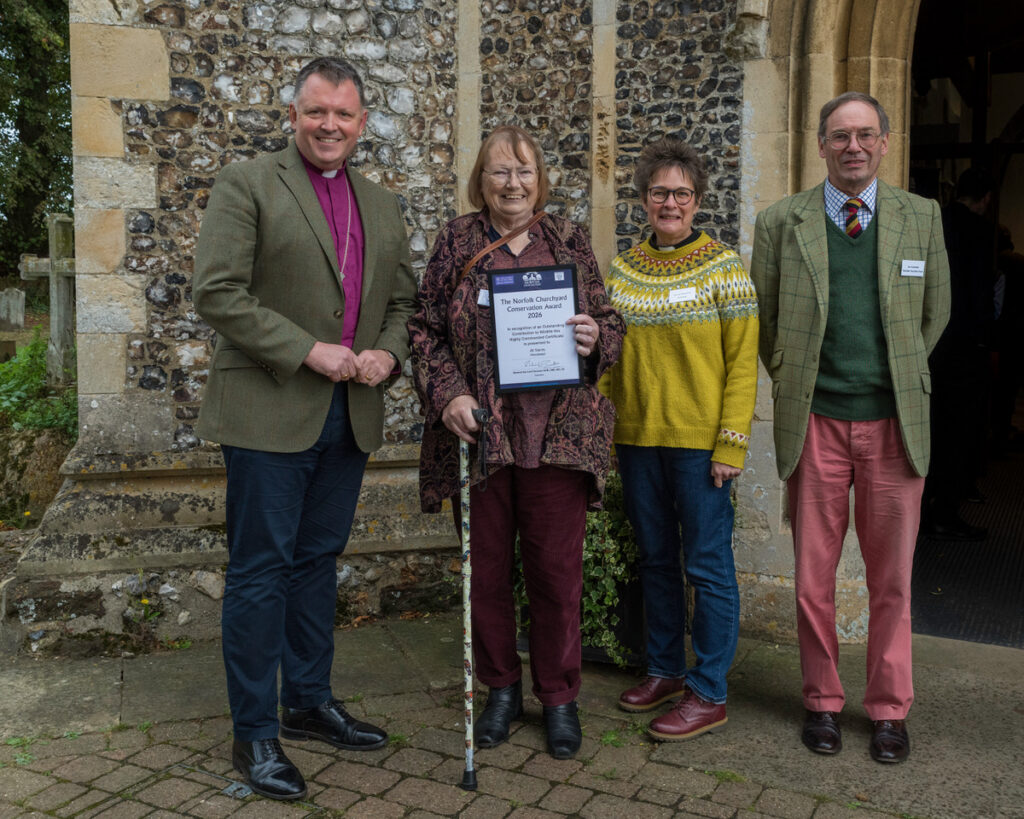
All Saints Church in Hemblington has been awarded the first-ever Norfolk Conservation Churchyard Award at the Sacred Spaces afternoon conference focused on biodiversity, conservation, and best practice in Norfolk churchyards, on Saturday 10 October 2026.
The Norfolk Churches Trust, celebrating their 50th Anniversary, launched the award in partnership with the Diocese of Norwich and Norfolk Wildlife Trust, to highlight the natural and spiritual heritage of Norfolk’s churchyards.
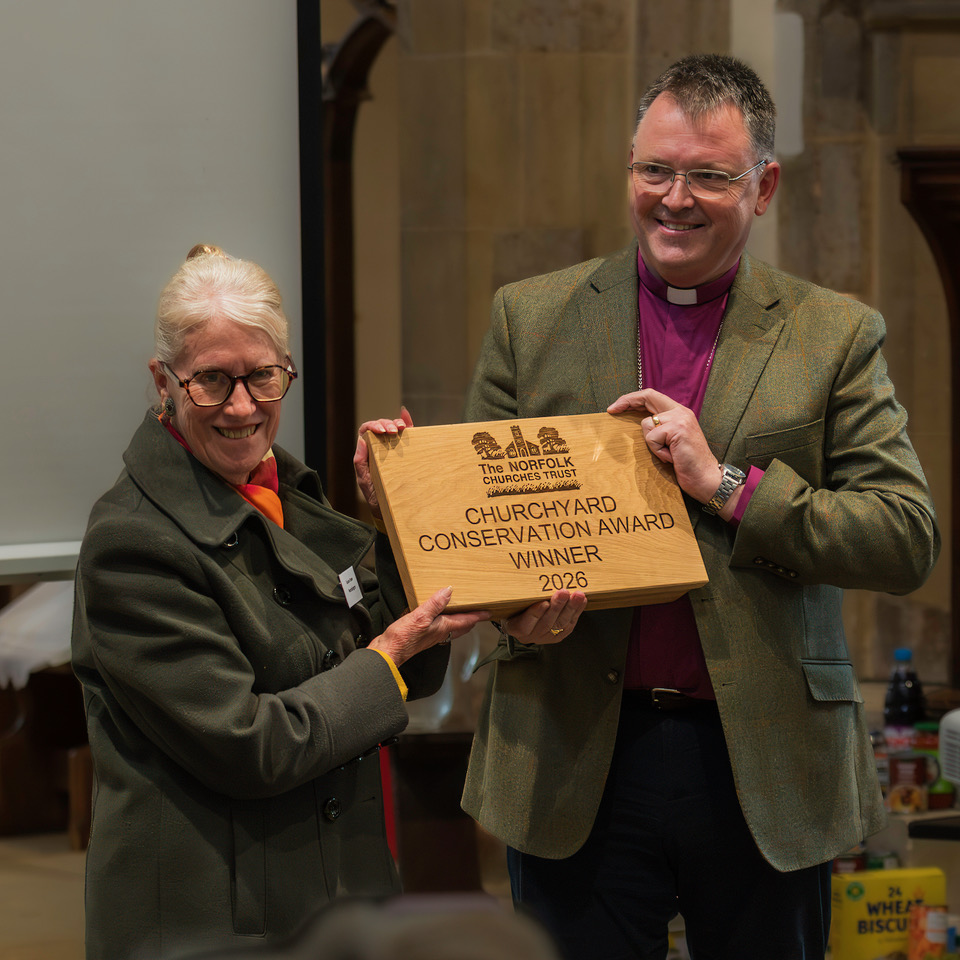
The Rt Revd Graham Usher, Bishop of Norwich and lead bishop on environment for the Church of England, presented Hemblington Church’s team with an engraved local-oak plaque and a cheque for £1,000.
Bishop Graham said: “Churchyards are not only sacred spaces but also havens for wildlife. This award recognises the vital role churches can play in environmental stewardship – celebrating those who care for these precious places in ways that benefit both people and nature. It has been heartening to hear of these excellent examples of this in action.”
The Revd Andrew Tapsell said: “This award is much deserved by the many volunteers who devote their time to care for the sacred space of Hemblington churchyard, especially those who are members of the church congregation, the Friends of Hemblington Church, and the Blofield and District and Bure Valley Conservation Groups.
“It is a testament to how the churchyard is managed in the interest of both human need and care for creation, and to have this recognised means so much to all involved in the life of our small and very special church. We hope that this award, which is set to become an annual occurrence, will inspire and encourage all the churches of our diocese to do what they can to manage their churchyards in ways that safeguard the integrity of creation and celebrate them as havens for wildlife and sanctuaries of peace.”
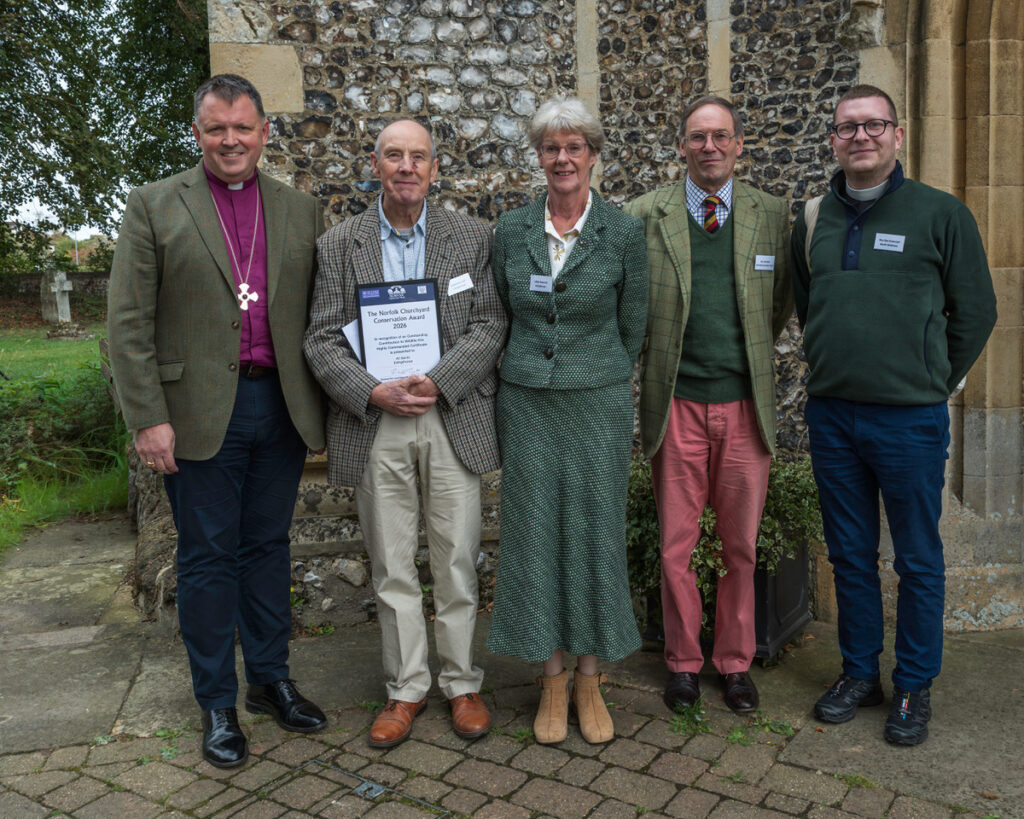
Further “highly commended” certificates were presented to All Saints, Edingthorpe, St Peter & St Paul’s, Blofield and All Saints, Horstead. The judging panel commented that there was very little to separate the top ten entries and that any one of them could have deserved a place in the final stage. They added: “We are grateful for the time and effort made by the churches in submitting their applications for the conservation churchyard competition. It has been a difficult task to judge the applications, and we can see that a great deal of excellent conservation work is taking place in churchyards across Norfolk. The overall standard is very high.”
Rosabelle Batt, Chair of the Norfolk Churches Trust, said: “Since 1930, England has lost an astonishing 97 per cent of its wildflower meadows. Yet within our churchyards, many of these rare plants and species survive, protected from pesticides. These spaces are living time capsules, havens of biodiversity and memory and their preservation has never been more important. This new award recognises the extraordinary value of churchyards as sanctuaries for nature, history and community and celebrates those who care for them.”
Lucy Seely, Norfolk Wildlife Trust’s Wilder Communities Officer, added: “This has been a great opportunity to recognise and celebrate all that our churches are doing to support wildlife in Norfolk. Churchyards are often the last remnant of ancient, undisturbed grassland in many parishes, and we have been running the Churchyard Conservation Scheme alongside the Diocese of Norwich for over 40 years in recognition of their importance for wildlife.
“Churchyards support wildflowers, ferns and lichens that are rarely found in the wider Norfolk countryside. Our churchyards can also be quiet havens for birds, insects, amphibians and mammals, and are important as green stepping stones for wildlife in the county.”
It is planned to run the Conservation Award annually from now on, and applications will open again on Saturday 31 October – more information here: https://norfolkchurchestrust.org.uk/events/churchyard-conservation-competition/
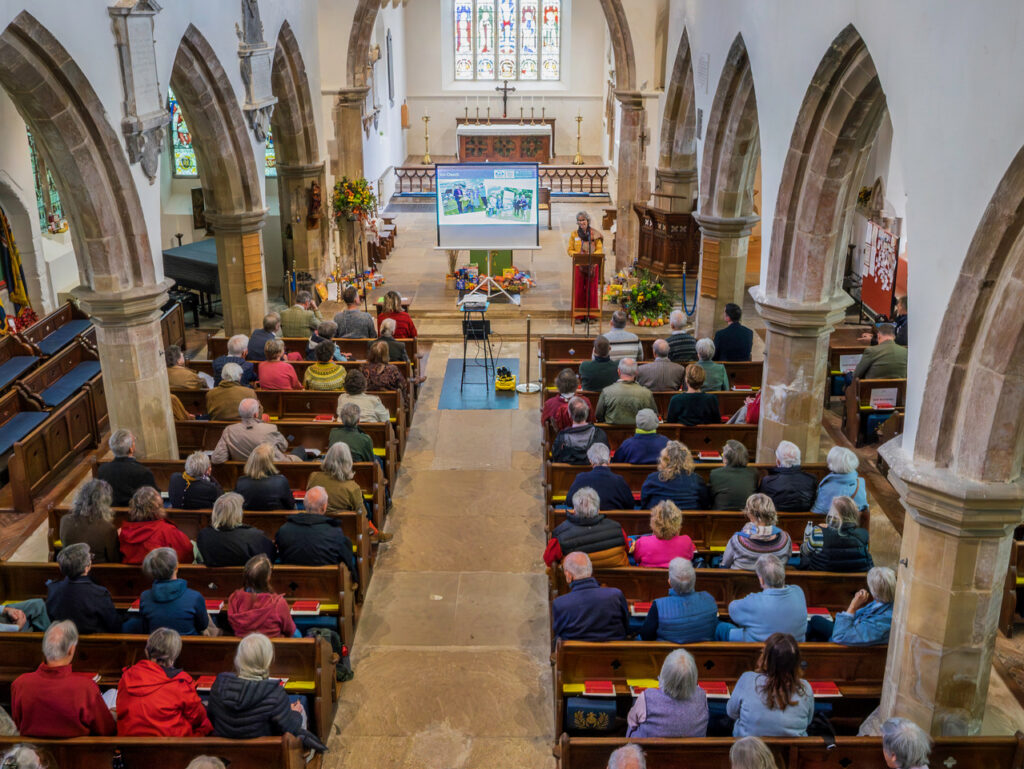
The Sacred Spaces: churchyards for nature afternoon of talks and stalls focused on biodiversity,
conservation, and best practice in Norfolk & Waveney churchyards was attended by over 100 people. They keynote speech was made by the Rt Revd Graham Usher, Bishop of Norwich and lead bishop on environment for the Church of England, and other talks were given by representatives from the Norfolk & Suffolk Local Nature Recovery Strategy, Norfolk Wildlife Trust and the Diocese of Norwich. You can view the video recording of all the speeches HERE.
For any queries or advice concerning improving biodiversity in your churchyard, please contact barbara.bryant@dioceseofnorwich.org or eliza.greenwell@dioceseofnorwich.org
Read on for further details of the award winner and shortlisted churchyards – great examples of best practice in terms of managing churchyards with both people and wildlife in mind:
HEMBLINGTON
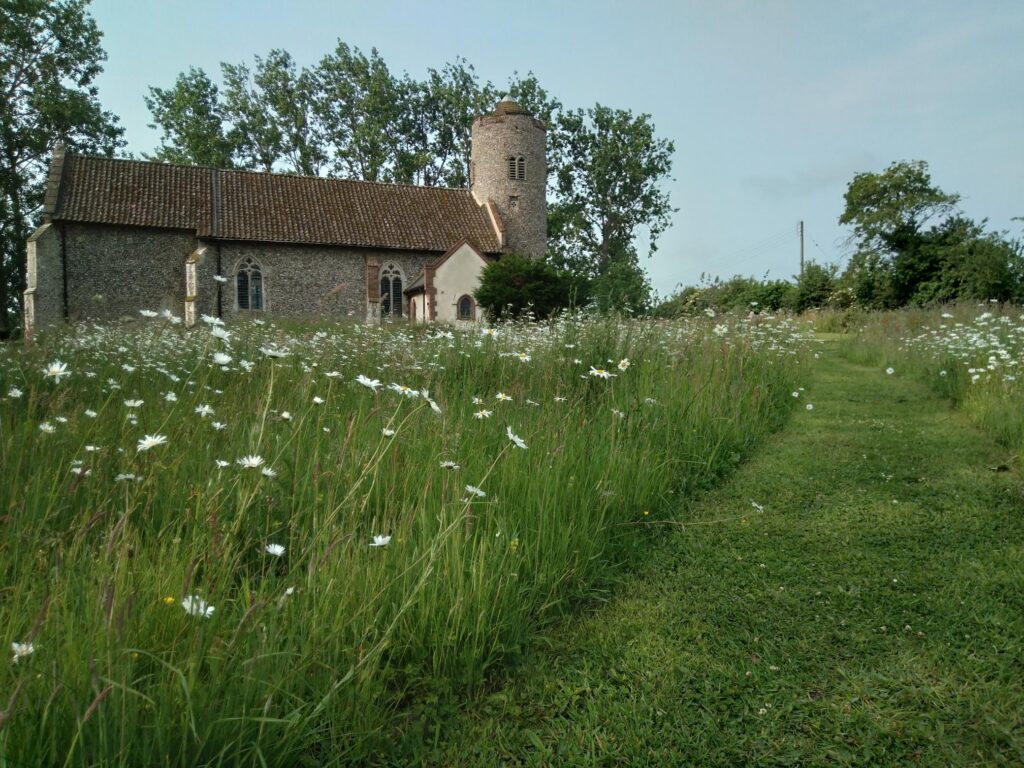
The small, round-towered medieval church of All Saints is set within the intensively farmed parish of Hemblington. There are two churchyards, both are managed to help provide a sanctuary for wildflowers and wildlife and give great pleasure to all who visit the church. These include the regular congregation, members of the Friends group, the many passing walkers and cyclists, and groups who wish to view the interesting pre-Reformation features within the church itself.
The southern churchyard has been cut and raked by Blofield and District Conservation Group since 1985, whilst the northern churchyard is cut and raked by the Bure Valley Conservation Group. The southern part is the most botanically diverse; whilst the northern part is making great progress, considering it was farmland until the 1950’s. In both areas, the regular summer cutting and raking off ensures the wildflowers prosper – with all the added benefits for birds, bees, butterflies, dragonflies – and visitors.
Monthly one-hour wildlife surveys have been undertaken by four members of The Friends group since 2017, recording wildlife seen in and around the churchyard. The group has organised bird-watching sessions to coincide with the RSPB’s Big Garden Birdwatch at the end of January. These surveys have shown us that wildlife is thriving, with over 100 species of birds and insects, 150 plant species and 16 kinds of tree at the last count. Many of these can be seen throughout our prayer walk that is located on the south side of the church.
We welcome people who would like to join us on our monthly wildlife surveys, work parties, or join the Friends of All Saints group. Together we can maintain the building and its grounds so that it can remain a thriving place for future generations to enjoy.
Species: Bluebell, crosswort, pignut, oxeye daisy, sweet vernal grass, common sorrel, bugle, woodruff, meadow buttercup
Groups who work on site: Blofield and District Conservation Group, Bure Valley Conservation Group, Friends of All Saints
HORSTEAD
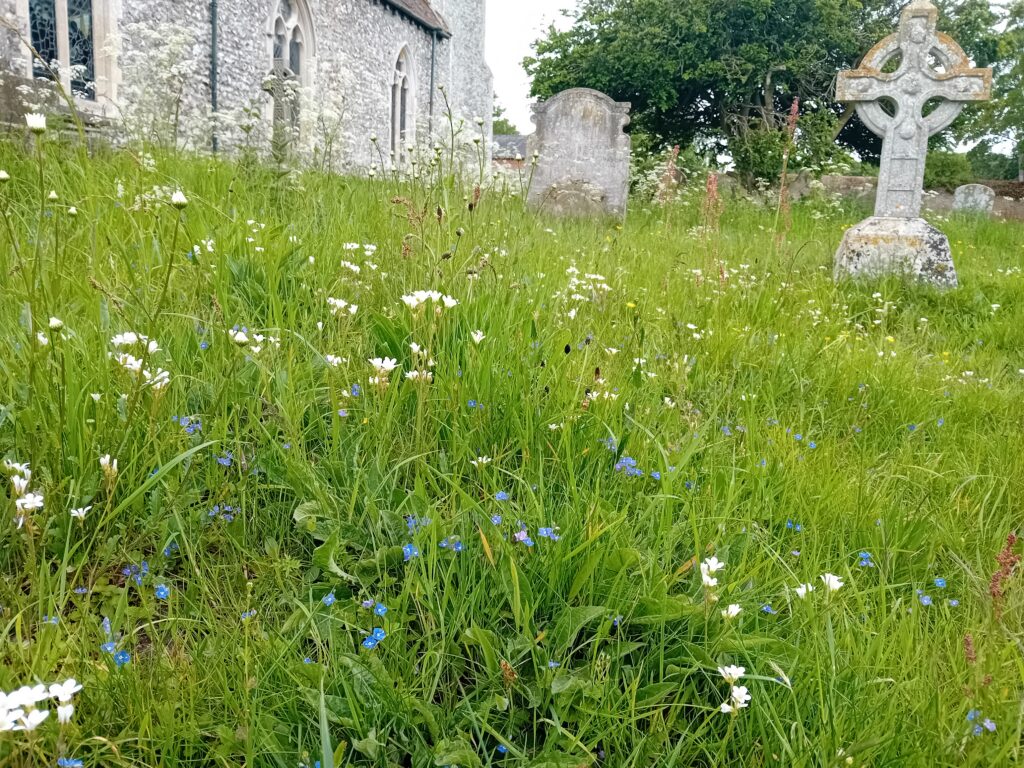
Horstead All Saints church stands up a secluded track close to the river Bure. It was founded by the Abbess of Cluny in 1355 and was given to the Priory because it was an important strategic crossing place from Norwich to Walsingham and the North. Many people explore its beautiful churchyard, which has a public footpath running through it. A piece of common land next to the churchyard leads to the village staithe on the river.
On the north side of the churchyard we have a conservation area that is 40 years old and was started by Dr Bob Leaney, who still keeps an eye on it. We have just started wildlife gardening on the south side of the church in an area that was rather neglected. We are working on a sensory theme to bring solace to visitors and provide a quiet space for some of the children with particular needs. Planting will include bird and insect friendly species.
Notable birds spotted in the area included a cuckoo, spotted flycatcher, kingfishers, heron, egret, and a charm of goldfinches. There are otters and water voles in the river and the churchyard hosts voles, field mice, moles, swallows and an occasional deer.
Our management plan includes community events which are themed around nature. Families canoe, climb, make nestboxes, learn about the Broads, discover lichens and birds, as well as take part in eco boat races and wild foraging. We also help families discover their heritage through crafts like weaving, stained glass art and environmental land art.
We now take part in the ‘Churches Count on Nature’. We work with two local schools to identify and sketch the birds and insects who live in and visit the churchyard. We hope to extend this work by using iNaturalist to collect data with the school groups from the Horstead centre and an adult community group as well.
Our conservation ground is old and precious, and we are starting to enjoy working in partnership with our neighbours to protect it and to introduce a new generation to its hidden worlds.
Species: Meadow saxifrage, lady’s bedstraw, oxeye daisy, germander speedwell, pyramidal orchid, cuckoo, spotted flycatcher,
Groups who work on site:Bure Valley ConservationCommunity Payback Scheme
BLOFIELD
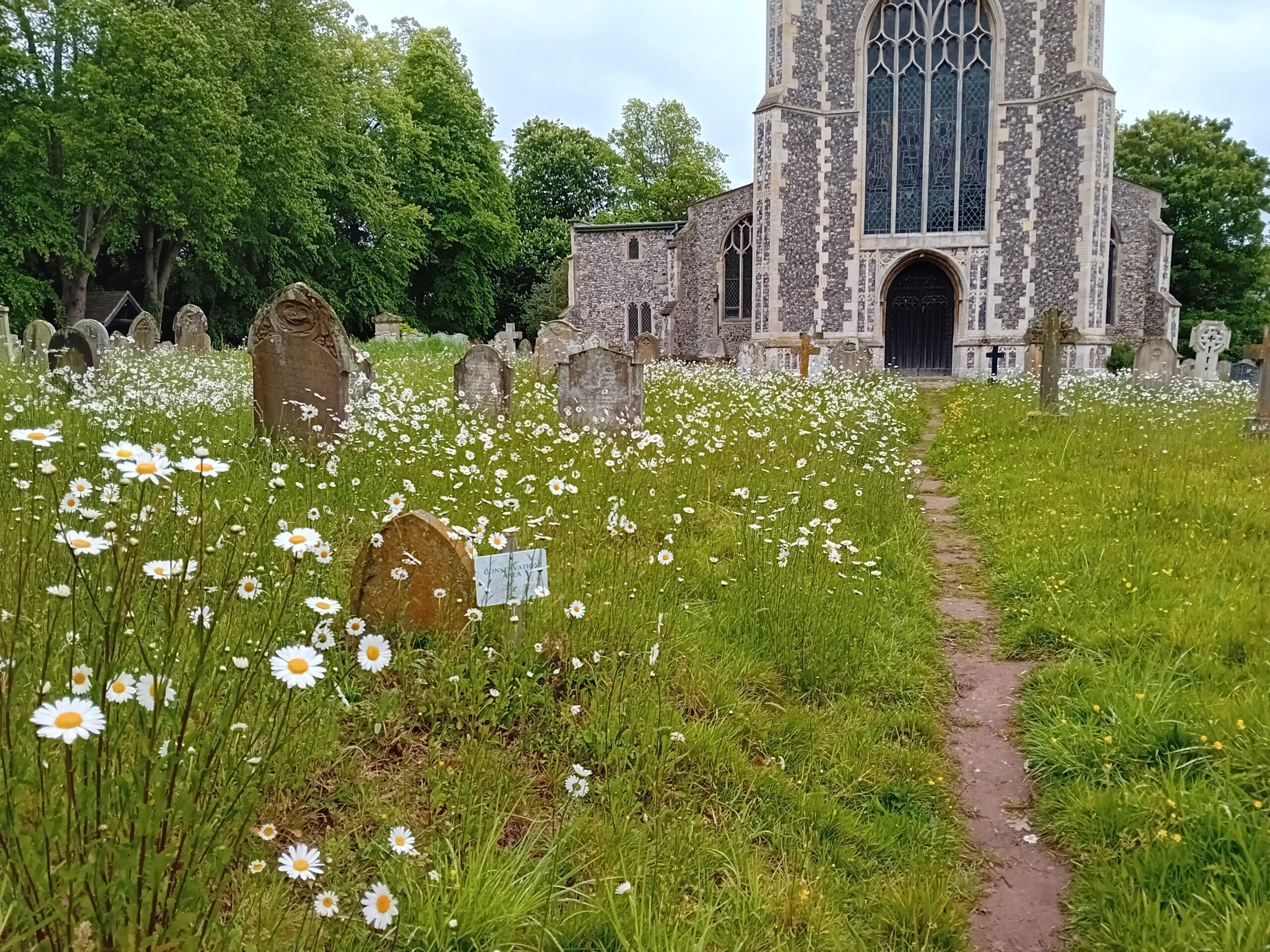
The churchyard is divided into two sections,: the original churchyard of the medieval church and the ‘new churchyard’, dating back about 100 years. The area contains unimproved grassland which supports an ancient hay meadow flora, with an abundance of oxeye daisy, meadow vetchling, common knapweed, yarrow, and hairy tare.
Many of the old headstones – particularly those made of limestone, – are coated in a rich assemblage of lichens, as is the impressive church tower. In addition, plants like pellitory-of-the-wall, mind-your-own-business, and colonies of intermediate polypody and hart’s-tongue ferns are found growing on the stonework.
The eastern and southern perimeters are of a wooded nature with lime, yew, oak, holly, beech and ash. Growing around and beneath these are dog’s mercury, bluebells and primroses. Along with our main conservation aim of preserving the species-rich grassland, we have planted several species of tree including buckthorn, wild pear and a wild service tree. We also maintain long patches of grass, stinging nettles, and log piles to provide a range of habitats to further support wildlife.
Mammals known to be present include pipistrelle bats, hedgehog, and field vole. Tawny owls frequent the larger, trees. Common pheasant and red-legged partridge visit the site. Toads, grass snakes and slow worms have been recorded.
In addition to the conservation management, the church encourages enjoyment of the churchyard as an open space for peace and contemplation. A ‘healing garden’ has been created at the base of the tower where there is a stone bench and a herb garden. We welcome people to enjoy our church and the surrounding grounds throughout the year.
Species: bulbous buttercup, pignut, lady’s bedstraw, meadow saxifrage, harebell, pyramidal orchid, barren strawberry, perforate St John’s-wort, germander speedwell
Groups who work on site: Blofield and District Conservation Group, Great Yarmouth Green Gym
EDINGTHORPE
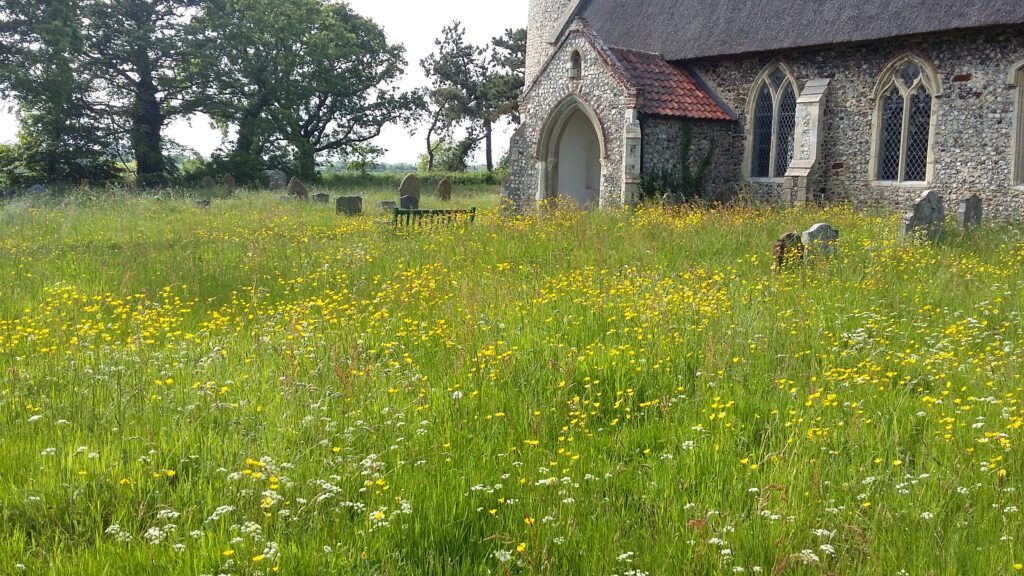
All Saints, Edingthorpe is a rural church surrounded by agricultural land. The churchyard represents a vital space for wildflowers to grow undisturbed by modern farming methods and for wildlife, particularly invertebrates, to take advantage of the richness they provide.
Locals and visitors alike seem to regard the churchyard as a tranquil haven, which in early spring is pinpricked with yellow winter aconites and lesser celandines. These are followed by carpets of snowdrops, bluebells and daffodils. The main event of spring and summer is the white, yellow and red of pignut, buttercups and sorrel, set off by tall slender grasses waving in the breeze.
Significant species include pignut, bulbous buttercup, meadow buttercup, common sorrel, germander speedwell, greater stitchwort, yarrow, sweet vernal grass, field woodrush and yellow oat grass. In the summer this area is cut and raked by volunteers, and the cuttings are then taken off site. The churchyard is bordered on all aspects by mature trees: ; there are 10 main species including oak, beech and yew.
Several species of butterfly are observable in the churchyard at relevant times of year, including the green-veined white, which is in decline nationally. The larvae of the small tortoiseshell, another declining species, have also been found. We regularly observe a number of species of day-flying moths. There are more than 70 species of fungi in the churchyard and many species of lichen, both on trees and older gravestones. Other species observed include frogs and toads, various beetle and bee species, and a variety of birds that frequent the churchyard.
Within our own small patch at All Saints, we are doing what we can to preserve some of the precious and limited resources available to wildlife.
Species: Bluebells, greater stitchwort, common sorrel, pignut, germander speedwell, small tortoiseshell, toad
Groups who work on site:
North East Norfolk Conservation Volunteers