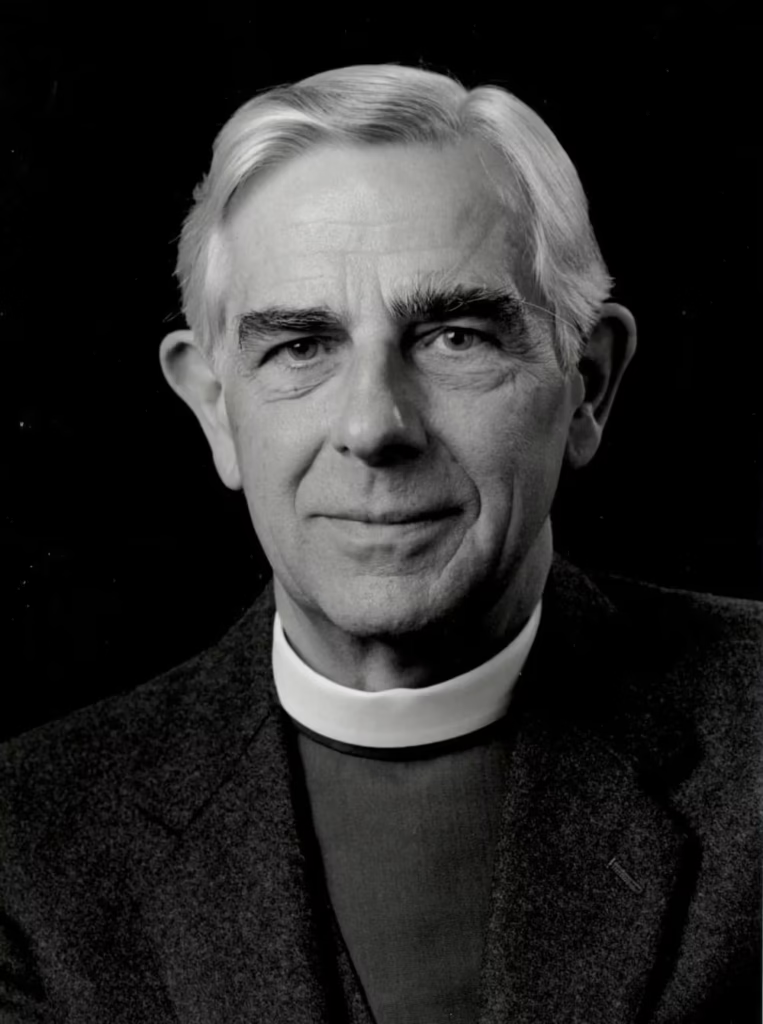

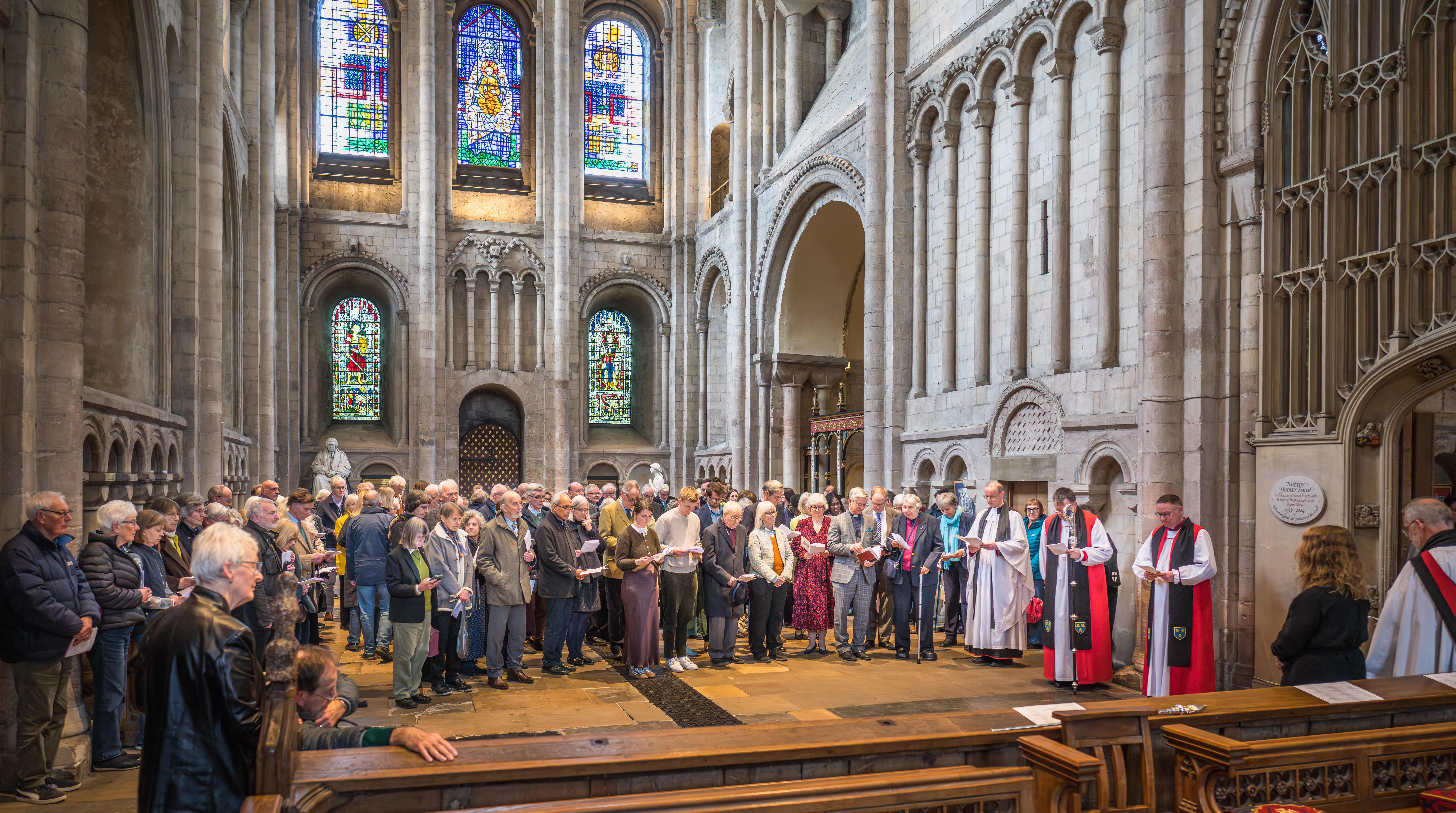
The life and legacy of Bishop Timothy Dudley-Smith was celebrated at a special Choral Evensong at Norwich Cathedral on Sunday 22 March.
Bishop Timothy served as Archdeacon of Norwich from 1973 to 1981, and then as Bishop of Thetford until his retirement in 1991.
He wrote more than 450 hymns and during Sunday’s service Norwich Cathedral Choir sang one of the most famous Tell out, my soul – as the Bishop of Norwich dedicated a memorial stone to Bishop Timothy in the Cathedral’s North Transept.
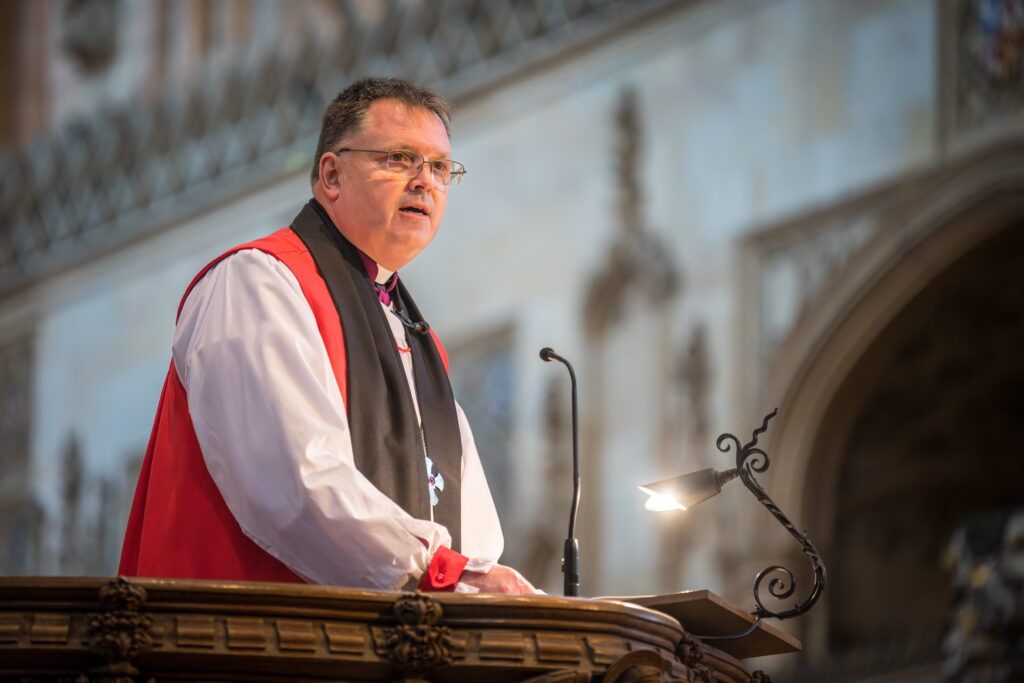
In his sermon (full text below) the Bishop of Norwich, the Rt Revd Graham Usher, said: “From his childhood in Buxton, God carved Timothy out from the Derbyshire stone in which he was set and gave him life, with the name Jesus etched on Timothy’s heart and proclaimed with his lips. Now, as we dedicate a plaque to his memory, Timothy’s name is chiselled again into Derbyshire limestone, but God’s Holy Word echoes through his hymns to be written in our hearts. Those words go on challenging us to make God the “Lord of our lives” and “to live for Christ alone.”
The service was attended by Bishop Timothy’s family, including his son, The Revd James Dudley Smith, who read the first lesson.
The second lesson was read by Songs of Praise presenter Pam Rhodes who also introduced Bishop Timothy’s hymn Name of all majesty. Another of Bishop Timothy’s hymns, Lord, for the years, was also included in the service.
Bishop Timothy died in Cambridge in August 2024, aged 97.
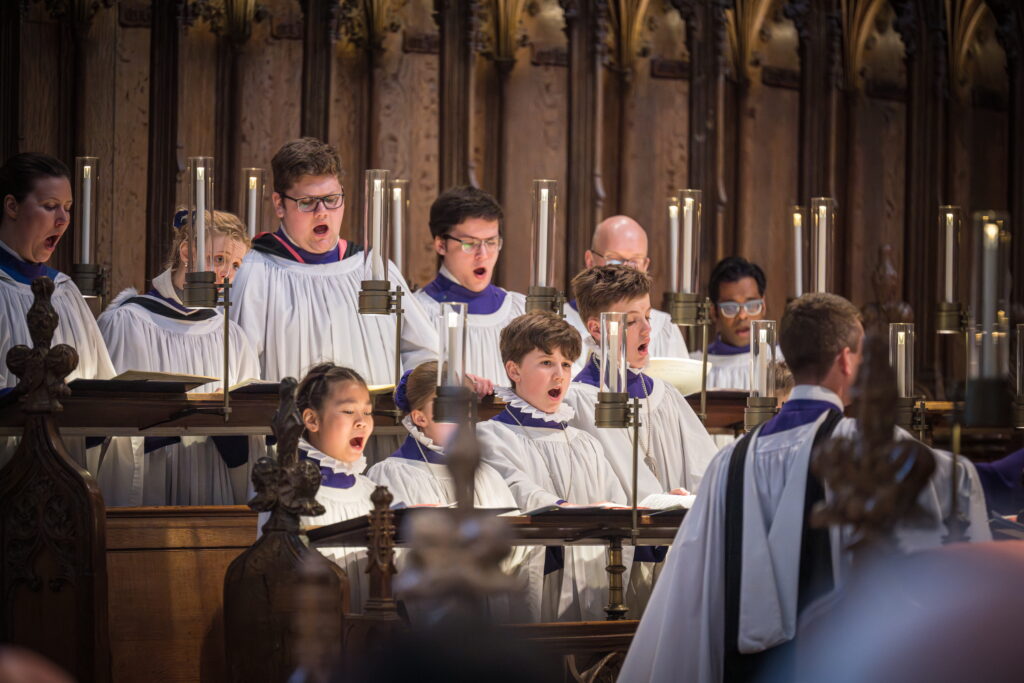
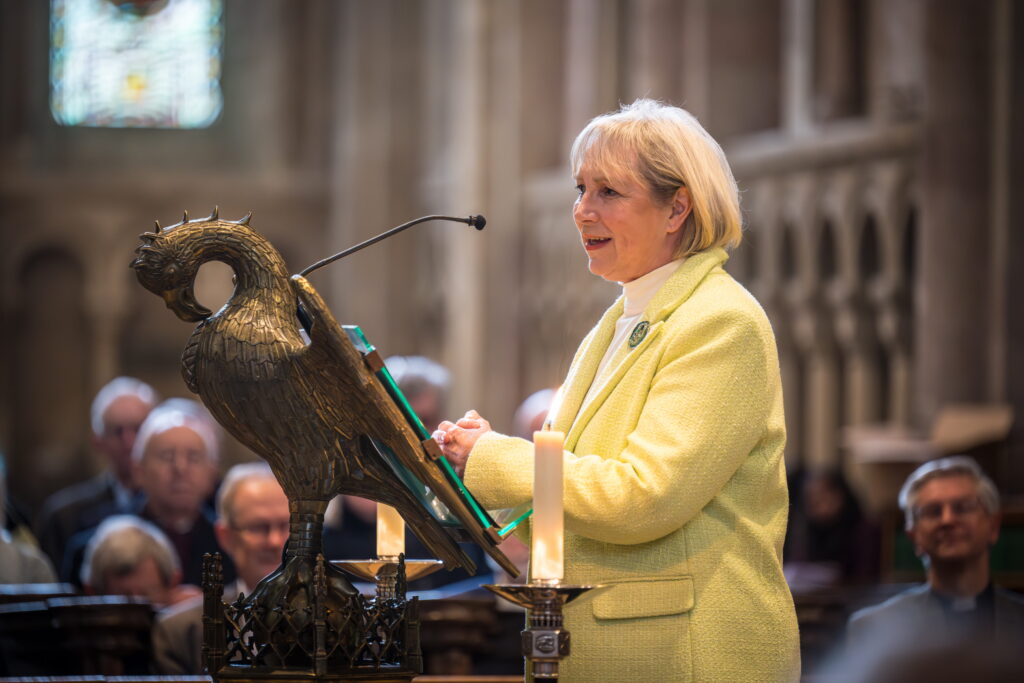
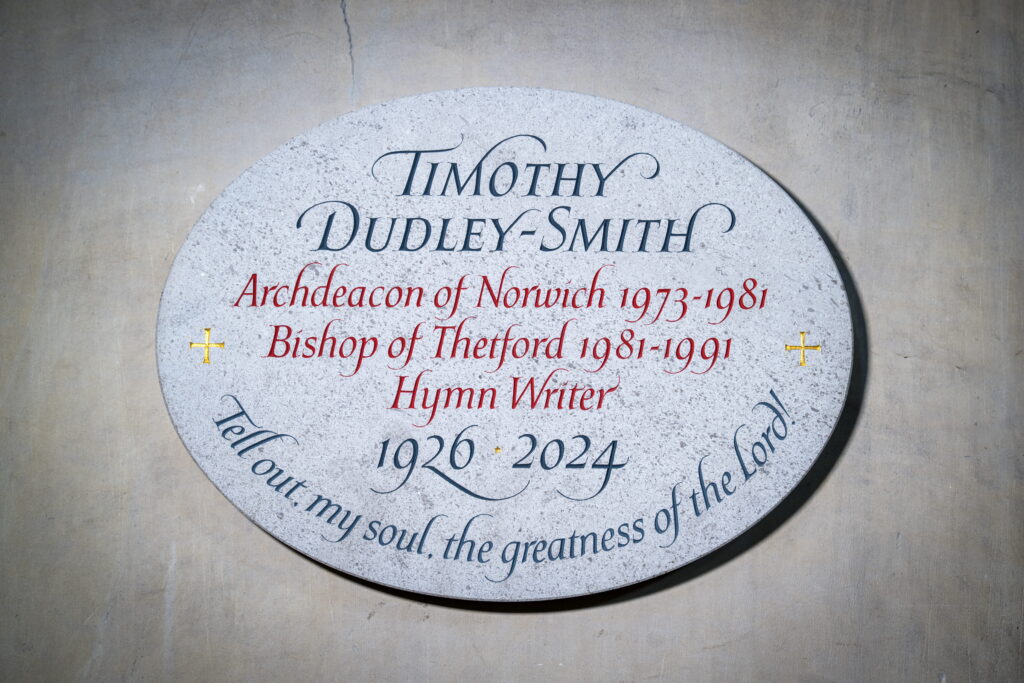
Pictures: Bill Smith/Norwich Cathedral
The Bishop of Norwich’s sermon at the Evensong dedication of a memorial plaque to Timothy Dudley-Smith
Jeremiah 31:27–37 and John 12:20–33
From this afternoon’s second reading: “Sir, we wish to see Jesus.”
A simple request. A desire that carries a depth that unfolds the more we sit with it. It isn’t a demand for explanation, argument, or doctrine. It’s simply a longing for encounter. These unnamed seekers don’t ask about Jesus; they ask to see him. They sought his presence.
On Dudley-Smith holidays each August in Cornwall their father would not be present until 11 o’clock each morning. Bishop Timothy said in an interview: “I would take my wife a tray of breakfast and the children would amuse themselves and I would try to write from 8.30 until 11am, when we went to the beach.” Even on holiday his eyes were seeking to see Jesus, pen and notebook in hand, tunes playing in his mind, words of scripture dancing and settling. No wonder that from the diocesan collection at Timothy’s retirement Arlette was specifically given a voucher to choose the next holiday!
In John’s gospel this moment of seeking to see comes just as Jesus begins to speak of his coming death. Paradoxically, the desire to “see” him is answered not with a spectacle, but with the revelation of a suffering, self-giving love. To see Jesus, in the Johannine sense, is ultimately to go on a journey to the cross — to recognize glory hidden in sacrifice, and life emerging through loss.
This resonates deeply with the hymnody of Bishop Timothy. His texts often take that same desire — to see, to know, to follow Christ — and give it language that is both clear and searching. In hymns like Lord, for the Years or Tell Out, My Soul, there is a movement from personal longing to communal proclamation. We begin by asking to see Jesus, but that is not a passive act; it reshapes the one who sees. It calls forth trust, obedience, and a reorientation of life. And it leads us towards becoming witnesses to what we have seen.
There’s also a quiet challenge embedded in both the Gospel text and these hymns. If others come to us — as they came to Philip — and say, “We wish to see Jesus,” what do we show them? Not arguments or abstractions, but lives that somehow reflect his character. Bishop Timothy’s hymns enables us to sing out our faith with joy and hope and thankfulness.
The reading we heard from Jeremiah longs for this joy and hope and thankfulness, spoken into a context of national failure and exile yet dares to proclaim a new covenant – not written on stone but on human hearts. Timothy picked up this theme when he wrote, “O God who gave the living word, no longer set in stone.” A living word of God’s replanting and rebuilding, reversing destruction with intimate restoration. A story that needs to be witnessed to as its finds expression again and again in our lives as we seek to see Jesus.
But where do we see Jesus? We see Jesus, I would suggest, in at least three unlikely places.
We see him, first, in the poorest, the lost, the least and the lonely; those who the world so often forgets. In Tanzania, gathered under a large tree, with people who had materially very little, and with climate change adversely affecting their crops, I remember singing Bishop Timothy’s “Fill your hearts with joy and gladness, sing and praise your God and mine.” Even in their need for gentle rain, rather than drought followed by deluge, they sang “Praise the Lord for times and seasons, cloud and sunshine, wind and rain.” Though I did wonder, in that baking, dry heat what the faithful made of the line “spring to melt the snows of winter.” Bishop Timothy’s hymns have been a gift to our worldwide Anglican church, a church made up very largely of the poor, or those serving the poor, in places of conflict, or emerging from conflict or natural disaster. If we watch carefully, we see Jesus in the poor, the mournful, the hungry who he calls blessed.
We see Jesus also in the blessed persecuted; those who proclaim their faith aloud or in silent resistance when it is put to the greatest test. We live in a time when the persecution of Christians is a frightening daily reality. There are those today who have had to gather to pray in secret, have had to hide their Bible (the most precious thing they own), and those who have had to flee their homes and become refugees because the name of Jesus is etched not on stone but on their hearts. Bishop Timothy’s words in the hymn “In my hour of grief or need” offer hope: “When the powers of evil ride through the world in open pride . . . sound anew the quickening word, rise and come among us, Lord!”
The third place we see Jesus is in Christ-like people; people who live the Gospel, those who slowly take on the voice and manner of Jesus; the meek, the merciful, the pure in heart, the peacemakers who speak in contemporary ways but infused with the way of Jesus. Not those who gossip and slander, but those who speak for the underdog and get alongside those who are struggling. Not those who go with the flow of greed and only think of themselves, but those who speak prophetically. “The humble hold your kingdom’s key”, wrote Bishop Timothy, “who see their lives as little worth, to them your word is given.” What a gift these hymns are, not just to Anglicans, but also beloved by our ecumenical sisters and brothers the world over.
For how Bishop Timothy kept desiring to see Jesus through his long life, how he has helped us to see Jesus, and how his concluding words in his final sermon as Bishop of Thetford in this cathedral were “And to him be the glory”, we thank God. From his childhood in Buxton God carved Timothy out from the Derbyshire stone in which he was set and gave him life, with the name Jesus etched on Timothy’s heart and proclaimed with his lips. Now, as we dedicate a plaque to his memory, Timothy’s name is chiselled again into Derbyshire limestone, but God’s Holy Word echoes through his hymns to be written in our hearts. Those words go on challenging us to make God the “Lord of our lives” and “to live for Christ alone.”