Diocesan Churchyard Regulations
The Churchyard Regulations set out the types of memorial which the Chancellor has authorised the clergy to permit. Where the Regulations are silent on any point there is no delegated authority to approve the memorial, and a faculty would need to be sought.
Faculty Jurisdiction
Section 56 and 57 of the Ecclesiastical Jurisdiction and Care of Churches Measure 2018 states that all church buildings, churchyards and curtilages are subject to Faculty Jurisdiction.
Maintenance of a Churchyard
Section 4(1)(ii)(c) of the Parochial Church Councils (Powers) Measure 1956 states that a Parochial Church Council is responsible for the maintenance of a churchyard. However, there is a procedure for transferring to a Parish Council or District Council the responsibility for maintenance of a churchyard which has been closed for further burials by Order in Council (see below).
Closed Churchyards
A churchyard is sometimes described as closed in the non-legal sense that burials have been discontinued there. But the term closed may be used in a legal sense to mean that a churchyard has been closed for further burials by an Order in Council.
Applying for a Closing Order
A Parochial Church Council may apply for a closing order when there is no room left for burials in a churchyard (apart from graves which have been reserved by Faculty but have not yet been filled). If a PCC is unsure as to whether a churchyard has been closed by Order in Council, an enquiry should be addressed to:
Burials Unit, Ministry of Justice, 4th Floor, 102 Petty France, London SW1H 9AJ.
Telephone: 020 3334 6413.
See also: Churchyard Closure Application Form and Guidance Notes.
Effects of Closure
No further coffin burials may take place in the churchyard, unless they fall within an exception specified in the closing order. It is common for a closing order to specify, by way of exception to the prohibition against further burials, that (a) burials may still take place in graves which have been reserved by Faculty, and (b) a body may be buried in the same grave as a relative, provided that following the second burial there will still be at least one metre of earth above the second coffin. When applying for a closing order, a Parochial Church Council should ask the Ministry of Justice to include these exceptions.
Cremated remains may continue to be buried in a closed churchyard, provided that either (a) a Faculty is obtained to authorise an interment, or (b) the cremated remains are to be buried in an area already set aside by Faculty for the interment of cremated remains.
The closed churchyard remains subject to the Faculty Jurisdiction, and the Parochial Church Council remains responsible for continuing to maintain the churchyard, unless and until it has transferred responsibility by giving notice under Section 215 of the Local Government Act 1972.
Note that section 3 of the Disused Burial Grounds Act 1884 prohibits the construction of any temporary or permanent buildings upon any disused burial ground, except for the purpose of enlarging a church, chapel, meeting house, or other place of worship. This restriction is still in force and applies to any disused burial ground, including a churchyard, whether or not it has been declared formally closed. Case law also indicates that while a churchyard remains open and available for further burials, nothing may be authorised in any part of it which would prevent that part being used for further burials.
Transfer of Responsibility
Under Section 215 of the Local Government Act 1972, a Parochial Church Council may give notice to the Parish Council (or, where there is no Parish Council, to the chairman of the Parish Meeting), requiring the Parish Council (or the Parish Meeting, as appropriate) to take over the responsibility of maintaining a churchyard which has been closed by Order in Council. Three months after the giving of the notice, the Parish Council (or Parish Meeting) becomes legally responsible for maintaining the churchyard, unless it gives notice under the Act to the District Council or Unitary Authority, requiring the District Council or Unitary Authority to take over the responsibility. Although the statutory period for giving notice to the Parish Council is three months, the General Synod Office suggested in 1981 that PCCs try to give Parish Councils at least twelve months’ notice, in order to allow Parish Councils time to make appropriate provision in their budgets.
In the case of a churchyard closed before the 1972 Act came into force, the Local Authorities etc (Miscellaneous Provision) Order 1974 provides as follows: “Where … the functions and liabilities of the parochial church council of a parish with respect to the maintenance and repair of a churchyard have under section 269(2) of the Local Government Act 1933 before 1st April 1974 been transferred to the council of the borough or urban district, or to the parish council, the authority on whom a request under section 215(2) of the Act would fall to be served shall maintain the churchyard by keeping it in decent order and its walls and fences in good repair.”
Once responsibility has been transferred, the Parish or District Council will have the same responsibility for maintaining the churchyard, and its walls, gates, fences, grass, trees, etc., as the Parochial Church Council had prior to the giving of notice to transfer responsibility. Advice is set out in Part 8 of Legal Opinions Concerning the Church of England, 8th Ed. 2007.
The Parish or District Council will need to apply for a Faculty to authorise any works in the churchyard other than routine maintenance, since the churchyard will remain consecrated ground.
Reusing Burial Space in Open Churchyards
The Chancellor has issued guidance for parishes regarding the re-use of old graves in churchyards: Re-Using Burial Space in Open Churchyards – Guidance November 2020
For further information please contact Joanna Pelan, Registry Clerk: Joanna-Pelan@birketts.co.uk
Burials
Before a burial may take place in a churchyard, the Incumbent or minister conducting the service must be satisfied that a ‘certificate of disposal’ of the body (“the green form”) has been issued by the registrar of births and deaths, or a corresponding order made by the coroner (see section 1 of the Births and Deaths Registration Act 1926). The certificate (or coroner’s order) should be produced to the incumbent before the burial. Clergy should ensure that their churchwardens are also aware of the need for the green form to be produced before the burial, so that the requirement is not overlooked if the regular parish clergy are unavailable for any reason.
Clergy and others (such as readers) taking a burial service are recommended to have in place a requirement that the green form should be produced to them at least 48 hours before a burial is scheduled to take place, to avoid any last-minute misunderstandings.
If the incumbent is satisfied by a written declaration that the certificate or order has been issued, but has been left behind or mislaid, the burial may proceed. However, the incumbent must obtain an undertaking that the missing certificate or order will be produced as soon as possible.
Before a burial is arranged, the bereaved family should consider the Chancellor’s guidance notes on churchyard matters:
Chancellor’s General Guidance on Churchyards – February 2016
Chancellor’s Guidance for Families on Churchyard Matters – February 2016
Exhumations
The Church regards interment as final and a Faculty for an exhumation will only be granted in exceptional circumstances. For the exhumation of a body or cremated remains from consecrated ground, it will be necessary to obtain Faculty permission from the Chancellor of the Diocese.
If the remains to be exhumed are in unconsecrated ground, then a licence will be required from the Ministry of Justice. Enquiries about obtaining an Exhumation Licence from the Ministry of Justice should be addressed to:
Coroners Unit, Ministry of Justice, 102 Petty France, London SW1H 9AJ.
Tel: 0203 334 6390 Email: coroners@homeoffice.gsi.gov.uk
The Church regards interment as final, and so a Faculty will not normally be granted to authorise an exhumation, except in exceptional circumstances, for example, where a body has accidentally been buried in a grave already reserved for someone else, or in any other special circumstances which the Chancellor of the Diocese considers justify a departure from the general rule. The law relating to exhumation is set out in the leading case of Blagdon Cemetery [2002] Court of Arches, in which the Court discussed the reasons which might be considered as justification for allowing an exhumation. These, in summary, are as follows:
- Medical Reasons – the deteriorating health of surviving members of the family, which may make it difficult for them to visit an existing grave, is not normally a sufficient reason to justify an exhumation.
- Lapse of Time – generally, the longer the period since the original interment, the more difficult it will be to show that removal of the remains is justified.
- Mistake – where a genuine mistake has been made, and remains have, for example, been buried in the wrong plot, or, contrary to the family’s wishes, in ground which was consecrated, a faculty may be granted. But a simple change of mind on the part of the surviving relatives about where the remains should be interred is not generally sufficient justification for the grant of a faculty.
- Local Support – the support of close relatives for the exhumation proposed will normally be required, but the support of third parties, such as friends of the family, local clergy and others, will not normally be a relevant consideration which the Court should take into account.
- Precedent – the Court will have regard to the possible effect of any faculty granted to authorise an exhumation in setting a precedent. The Court will not wish to establish a precedent which undermines the general presumption that interment is intended to be final.
- Family Grave – the Court will have regard to the existence of an established family grave plot, and may be prepared to grant a faculty for exhumation where the intention is to bring the remains of family members together in one plot.
Each proposal for a Faculty to authorise an exhumation will be considered on its particular merits, but the general presumption is that exhumation will be authorised only if the circumstances are exceptional.
The application form for a Faculty is called a Petition and applicants should read the accompanying guidance notes carefully when considering whether to make an application. The forms can be obtained from the Diocesan Registry Clerk. The guidance notes explain in the detail both the process and fees. The Fees are set out in The Ecclesiastical Judges, Legal Officers and Others (Fees) Order which is updated on 1st January every year. The current application fee for 2026 is £362.40 and is non-refundable should your application be unsuccessful.
Memorials
There is no legal right to place a memorial in a churchyard.
The Chancellor has given authority to clergy to allow memorials which fall within the guidelines set out in the Churchyard Regulations. For cases falling outside the regulations, there is a simplified faculty procedure for applying to the Chancellor for permission to introduce a memorial into a churchyard.
The members of the National Association of Memorial Masons work to accredited standards, and the Association will provide contact information for memorial masons working within the Diocese.
The Diocese is keen to encourage good quality interesting and imaginative memorials within its churchyards where appropriate. For the contact details of lettercutters and stone carvers producing unique, bespoke memorials and other artwork please get in touch with Nicholas Cannon or Eliza Greenwell.
Anyone wishing to place a memorial in a churchyard should send a completed Memorial Application Form 2021 to the incumbent of the church before placing an order with a stonemason.
Diocesan Churchyard Regulations
The Churchyard Regulations set out the types of memorial which the Chancellor has authorised the clergy to permit. Where the Regulations are silent on any point there is no delegated authority to approve the memorial, and a faculty would need to be sought.
Fees
For full details of the fees payable please refer to the current version of the Parochial Fees Order, currently the Parochial Fees Table 2026 which you can review here.
Testing of Churchyard Memorials
PCC’s (and Parish Councils in the case of closed churchyards) should note that they have a responsibility for ensuring the safety of their churchyards, including any memorials, and should undertake a regular check to identify any potential problems. If a memorial has been identified as presenting a risk to health or safety, advice should be sought from Nicholas Cannon or Eliza Greenwell as to how this should be dealt with.
Guidance on the safety of memorials is available at Managing the Safety of Burial Ground Memorials
Memorials inside Churches
As a general rule, the erection of memorials inside churches is not normally permitted. Anyone wishing to erect a memorial inside a church must apply for a Faculty, and must satisfy the Chancellor that a departure from the normal rule is justifiable, for example, because the person to be commemorated was a major benefactor of the church, or made some major contribution to the church or parish, or was an important local or national figure, etc. Once installed, the memorial becomes a fixture of the church and therefore owned by the incumbent as part of the building. For guidance on plaques in churches click here.
Reserving a grave space or cremation
It is possible to apply for a Faculty to reserve a grave space or cremation plot in a churchyard. Any parties interested in making an application should discuss this with the Incumbent and PCC first.
Reservations can be requested for a single or double depth plot for close family members. There are additional guidance notes to help with applications, and these and the Faculty application form are available from the Diocesan Registry Clerk, or click on the links below.
A Faculty application fee is payable on submission of the application. The fee as of 1 January 2026 is £362.40 and is prescribed by The Ecclesiastical Judges, Legal Officers and Others (Fees) Order, updated in January each year.
Unless there are exceptional circumstances, a reservation will not normally be granted to anyone who is under 50 years of age, and the reservation will last for a maximum of 30 years. This is to avoid blocking spaces in churchyards for unduly long periods of time. However, where there is space in the churchyard for less than 30 years’ worth of anticipated burials, any Faculty is likely to be limited to a shorter period, to match the expected capacity of the churchyard. So if there is only room for ten years’ worth of burials/interments, any reservation is likely to be limited to just ten years, unless there are exceptional circumstances justifying a departure from this policy. Generally the Chancellor is not keen to grant a reservation where there is less than 15 years of available space in the churchyard.
Where limited space in the churchyard means that a reservation is granted for a period of less than 30 years, it is possible for applicants to offer reasons to explain why their particular circumstances might justify a grant of a reservation for the full 30 years. However, where this means that a considered Judgement is needed from the Chancellor, an additional fee may be incurred.
The application will need to be supported by the Incumbent, Churchwarden(s) and the Parochial Church Council (PCC). Anyone wishing to reserve a space in a churchyard should first discuss the proposed reservation with the Incumbent and/or one of the Churchwardens to see whether space is available and if they would agree to a reservation being made. The PCC will want to consider the rate at which the churchyard is filling up, and how many spaces remain available; and therefore whether it is appropriate to set aside a space or spaces for reservation. The PCC is under no obligation to support a proposed reservation, and may wish to be cautious about support for reservations when space is limited.
On submission of the Petition to the Diocesan Registry, the Registrar will direct that Public Notices are published at the church, to give notice of the application to other parishioners and an opportunity for any objections. The Notices have to be displayed for 28 days. If no notices of objection are received by the Registrar within that time, the application will be submitted to the Chancellor.
An additional fee may be payable to the Parochial Church Council when applying for a reservation, to contribute toward future maintenance of the reserved plot.
Where, for example, close family members such as a husband and wife desire to be buried together, they may either
(a) Make one application for them both to be buried in the same plot, in which case only one set of fees is payable; or
(b) Make separate applications for the reservation of two adjoining grave spaces, in which case two separate Petitions with two sets of application fees would be required.
Making an Application
When submitting an application to reserve a grave space or cremation plot to the Diocesan Registry, the following will be required:
- Payment of the Faculty application fee of £362.40 (payable to Birketts LLP)
- The Petition form fully completed and signed by the applicant(s)
The following information is also required, but can follow at a later date:
- The written consent of the Incumbent and Churchwarden(s) to the proposed reservation (where there is no Incumbent the Rural Dean must be consulted);
- A signed Resolution of the PCC confirming its approval of the proposal;
- A churchyard plan showing the precise location (preferably with a plot/row number) and size of the plot to be reserved (usually 6x3ft for a grave space, or 1x1ft for a cremation plot), and the name of whose memorial the plot is next to if applicable;
- An estimate from either the incumbent or churchwardens as to the amount of available space in the churchyard in years (total number of available plots divided by average number of burials per year).
Please follow the links below for the Petition (Faculty application form) and guidance notes, or contact the Diocesan Registry Clerk and these can be emailed or posted to you.
- Petition – Grave Space or Cremation Plot Reservation
- Guidance Notes – Grave Space or Cremation Plot Reservation
- Guidance Notes – Faculty Petitions and Consistory Court Proceedings (January 2025)
For further information please contact Joanna Pelan, Registry Clerk: Joanna-Pelan@birketts.co.uk
Managing Biodiversity in Churchyards
Our churchyards are safe havens for a wealth of species, some of which are rare and/ or protected. The below links offer advice on how to encourage, protect and promote biodiversity and how to discover what your churchyard is home to.
Caring for God’s Acre provides a wide range of resources to assist with sensitive churchyard management.
- Managing Churchyards and Burial Grounds
- Havens for Wildlife
- Burial Grounds through Time
- Involving People
Norfolk Wildlife Trust’s Churchyard Conservation Scheme
Norfolk was historically rich in lowland meadows and the beautiful and diverse displays of wildflowers that this ancient habitat supports. This was at a time before agricultural intensification, with meadows being managed in traditional ways such as for grazing or hay cutting, allowing wildflowers to flourish. However, since the Second World War this low-intensity, sympathetic management has been replaced by widespread application of fertilisers, herbicides and large-scale reseeding and ploughing up of meadowland. It is estimated that since 1945, 98 percent of our wildflower meadows once widespread in the countryside have now vanished.
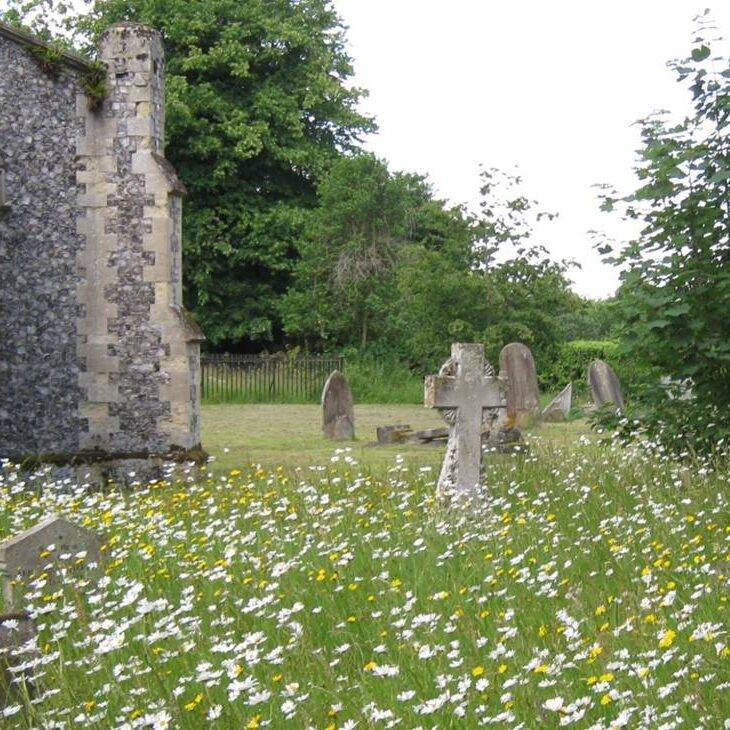
Nowadays, churchyards often form the only remaining fragments of old wildlife-rich meadow in a parish, serving as island refuges for local wildlife, including birds, butterflies, bees, hedgehogs and slow-worms to name a few. There are six species of meadow plant that are now deemed dependent on churchyards for their survival in Norfolk and a number of churchyards even support orchid populations if allowed to survive the spring and summer months.
Recognising this, the Norfolk Wildlife Trust Churchyard Conservation Scheme was set-up over 30 years ago with the aim of encouraging and supporting churches to manage their churchyards with wildlife in mind so that they may continue to offer sanctuary in our ever fragmented and degraded landscapes.
Under the scheme, it has surveyed and given free advice to hundreds of churches in Norfolk. Each year a team of dedicated volunteer churchyard surveyors visit dozens of churchyards to survey them and identify the best areas for wildflowers and other wildlife. They then provide a report giving detailed results, along with some basic and clear advice on how parts of the churchyard could be managed for wildlife (such as establishing a Conservation Area), whilst ensuring the churchyard remains cared-for, accessible and able to perform its primary purpose, promoting the area as a place of refuge for both people and wildlife. If a church would like to manage a part (or in some cases all!) of their churchyard for wildlife, then they can become part of the scheme and display a Norfolk Wildlife Trust Churchyard Conservation Scheme plaque.
The service is free and more information can be found here.
If you would like to be added to the list of churchyards to be surveyed next year, receive an information pack or have any questions, please email churchyards@norfolkwildlifetrust.org.uk or call 01603 625540.
Moles
All insects and animals who are attracted to a churchyard contribute in some way to its biodiversity and moles are no exception. Exterminating or trapping to release moles is not recommended as it is costly, inhumane and ineffective. Other moles will soon move in to colonise the vacated space. Molehills may be unsightly but can be removed or flattened. If their presence is deemed too inconvenient, moles can be deterred by humane methods outlined in the RSPCA guidance ‘Living with Moles’.
As they move in the top 18 inches of soil, moles do not damage burials. They are beneficial for the aeration of the soil and with drainage as they are constantly moving along their tunnels searching for earthworms. They do not eat roots of plants, although they may dislodge them by accident.
DOs
- Leave areas of the oldest graves uncut from April until end July/early August. Then cut and REMOVE the grass cuttings. Repeat in October if resources allow. This will allow any meadow plants in the seedbank to grow, flower and set-seed. Sometimes species can come up that have been dormant for decades.
- Leave a strip of vegetation along one side uncut until October each year. This strip can act as a refuge and food source for a range of invertebrates, small mammals, reptiles and amphibians.
- Leave a few holes in walls or fences, as well as any ‘untidy corners’. It will allow access to and from the churchyard, as well as refuge/hibernation opportunities for hedgehogs.
- Pile any dead wood/branches into an undisturbed corner. An often-overlooked habitat that supports a huge array on invertebrates.
- Put up bird and bat boxes in churchyard trees to provide safe nesting / roosting.
- Keep grass paths and areas of tended graves mown regularly. Mow a neat edge to gravel paths and any conservation areas. It will maintain access, neatness and signals intentionality rather than neglect.
- Put up signs telling visitors why an area is being left. This will raise awareness of the importance of the churchyard for local wildlife and encourage visitors.
DON’Ts
- Spray herbicides and pesticides. It may kill native wild flora and/or pollinators and invertebrates that are food e.g. for hedgehogs.
- Scrub tombstones to remove lichen. Churchyards are a haven for lichen in Norfolk, due to the lack of natural rocky outcrops.
- Cut trees and hedges every year, and especially not during the bird breeding season (March – August). Hedgerows support numerous species of invertebrate, small mammal and bird amongst other groups. They provide shelter, food and a safe place to nest. Try to cut only every three years.
Wildlife in church buildings
Church buildings also provide a home to wildlife!
- Bats in Churches
Do you have bats in your church building? We have designed a poster to help visitors understand what this means in practice, as well as sharing useful advice and tips on managing the site in accordance with legal protections afforded to bats. Download a copy to print and display in your church here. - Swifts a Church Guide Project Pack
We are excited to present Swifts: A Church Guide Project Pack, a simple resource designed to assist you in successfully managing a swift project to install swift boxes in your church. This guide provides detailed information about swifts, why swifts are important and step-by-step instructions to undertake a project to install swift boxes in a church with additional resources linked.
Commonwealth war graves
The Chancellor has issued an Additional Matters Order for the installation of standard form Commonwealth War Grave signs in churchyards within the Diocese by The Commonwealth War Graves Commission. This means that the installation requires List B (Archdeacon’s) permission via the Online Faculty System.
In the application please can you include:
- PCC minutes approving the proposals
- The proposed location and fixings
The signs installed shall be of the style above (with singular or plural wording) and either 230mm x 420mm or 150mm x 210mm in dimension. They can be fitted to walls, gates or railings. All signs are provided, installed and maintained free of charge by the Commission.
Once List B permission has been granted, you will need to contact the Commission to arrange for the installation on signs@cwgc.org or 01628 507200.