

Flood awareness community resilience in your benefice (draft)
The Church’s calling in a time of climate crisis
In moments of disaster and uncertainty, the Church is often looked to as a steadfast presence. We are called to respond prayerfully, pastorally, and prophetically. This guidance aligns with the Diocesan Vision, offering three pillars of response:
Prepared by the Diocesan Environmental Working Group, this guidance is offered in support of Incumbents, Churchwardens, and PCCs, especially in areas at risk of flooding. It draws on information from the Environment Agency and other trusted sources and is intended to help you prepare, respond, and stand with those impacted by flood events.
A Changing Landscape: Understanding the Context
Flooding in Norfolk and Suffolk—whether from rising rivers or coastal surges—is not a new phenomenon. But today, the story is shifting. The effects of rising temperatures as a result of climate change will result in more frequent and intense storms in addition to a rise in sea levels, giving a potential increase of severity of flood and storm events.
From the historic floods of 1287 in the Broads to the devastating tidal surge of 1953 that claimed 82 lives in Norfolk and North Suffolk, we are reminded that these waters are not just part of our past—but part of our future.
Recent floods in 2020 and 2023 have shown that even in our time, communities can be caught off guard and deeply affected. In the face of such realities, the Church has a vital role—not just as a place of refuge, but as a beacon of hope, support, and leadership.
Prayerful
Create regular space for prayer—for the safety of our communities, for healing after devastation, and for wisdom in facing environmental change.
Compassionate God, source of all comfort, We pray for the people whose lives have devastated by rain and flood. Bring them comfort, we pray. Protect the vulnerable. Strengthen the weak. Have mercy on all those working to rescue the stranded . And may our response to their suffering be generous and bring you praise. For we ask it in Jesus’ name, Amen.
Encourage prayers for creation, justice, and those most vulnerable to climate impacts.
· See our own Porch Prayers booklets that have some content that may be helpful : https://www.dioceseofnorwich.org/wp-content/uploads/2025/07/Porch-Prayers-Final.docx https://www.dioceseofnorwich.org/wp-content/uploads/2025/07/Porch-Prayers-additional-resources-final.docx Also Resound Worship’s Downcast Souls Expectant Hearts
Pastoral
Listening & learning
- Seek to understand how flood risk affects your local area—geographically, emotionally, and spiritually.
- Create space to listen to community concerns, fears, and hopes.
- Facilitate discussions around preparedness, resilience, and support networks.
Offering pastoral support
- Offer the church as a place of emotional and spiritual healing after a flood.
- Walk with those affected—not just in the moment, but through the long months of recovery.
- Partner with agencies to provide both comfort and practical support.
Prophetic
Creating community forums
- Offer church buildings as safe, welcoming spaces for open conversations.
- Be a neutral and trusted gathering point for community planning and discussion.
- Help communities explore options, voice concerns, and develop grassroots solutions.
Offering practical help
- Identify church spaces or parishioner homes that could offer temporary shelter or assistance during emergencies.
- Where possible, mobilise volunteers to support neighbours affected by flooding.
Being a voice for justice
- Speak up for those who feel powerless in the face of environmental change.
- Advocate for those whose livelihoods, homes, or heritage are at risk.
- Work with local councils, emergency services, and community leaders to ensure that flood resilience and recovery plans are inclusive and effective.
Caring for creation
- Encourage every church to deepen its environmental commitment through actions like Eco Church.
- Recognise that flood resilience is part of our broader spiritual responsibility to safeguard God’s creation.
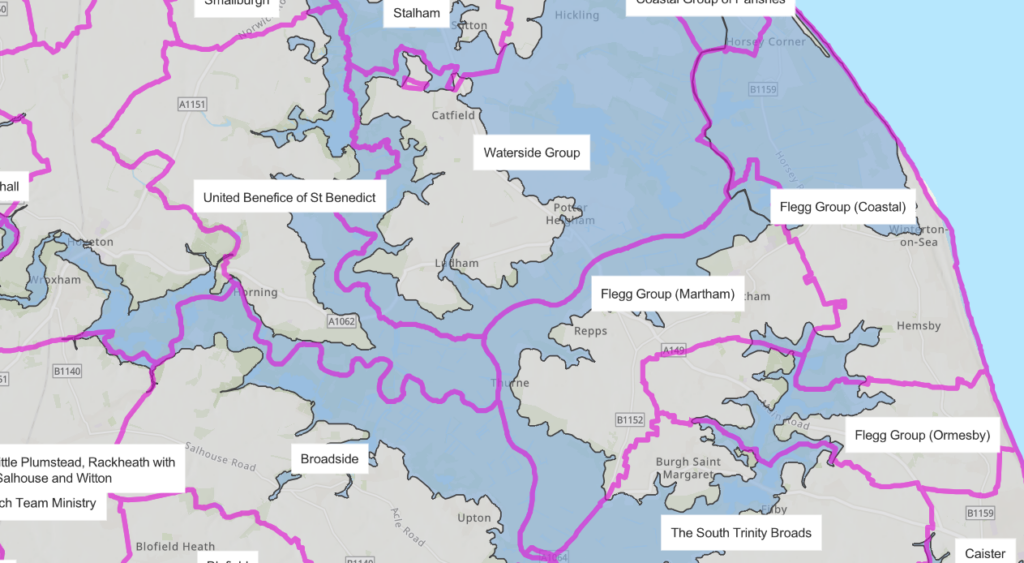
Click on the map below to view your area.
Further guidance: · GOV.UK Flood Information
- Norfolk Flooding Hotline: 0344 800 8013
- Environment Agency Flood Line: 0345 988 1188
- Norfolk Resilience Forum · Suffolk Flood Plan (PDF)
(These links will be reviewed and if necessary updated annually.)
Building Resilient Communities
The Autumn 2023 floods reminded us of two sobering truths:
1. Road networks can fail—leaving towns and villages isolated.
2. Flood recovery is a long journey—lasting months or even years.
But we also learned this: The Church’s rooted presence—urban and rural—is a blessing in such times.
You are encouraged to:
- Share flood information in high-risk areas through talks, newsletters, and worship.
- Build a local network of parishioners who can help in times of emergency.
- Collaborate with Parish Councils and local authorities to contribute to the local resilience plan.
- Bi-annually review your local information above at your PCC meeting to ensure that it is kept updated. Add action points where necessary.
- Consider this being a similar offer to the “warm spaces” that many churches already use their building for
- Mention this “flood-ready” intention in any funding applications you may be making to enable building improvement.
Hope Amid the Waters
The floods may come—but so does the rising of compassion, cooperation, and courage.
As the Body of Christ, let us be known not only for our prayers, but for our preparation, our presence, and our prophetic witness. Let us stand with our communities—not just to weather the storm, but to rebuild with hope.
“When you pass through the waters, I will be with you.” – Isaiah 43:2