“It’s your history, not mine, and you should have it on your wall.”
A man who travels all the way from Alaska once a year to carry out metal detecting in Norfolk has discovered a potentially unique piece of brass which dates back to the fifteenth century.
The brass was discovered near Holy Trinity Church in Ingham. The church was formerly the conventual church of a Trinitarian priory which unusually, was used jointly by the priory and the parish.
Tim Pestell, Senior Curator of Archaeology at Norwich Castle Museum and Art Gallery explains more:
“Ingham’s Trinitarian Priory was founded in 1360 by Sir Miles Stapleton who was an English Knight and one of the founding members of the Order of the Garter. Ingham can be seen as a status symbol of his position in society.”
The Order of the Most Holy Trinity for the Redemption of Captives, or Trinitarians, was a Catholic religious order founded in 1198 to ransom Christian captives taken during the Crusades. There were only ten houses in England, of which Ingham was the last founded. It is now the only Trinitarian house in England with any surviving buildings.
The priory stopped functioning before formal suppression and was dissolved around 1536. Today, it is known as Holy Trinity Parish Church.
Tim knows the parish well;
“I curate the archaeology collections at Norwich Castle Museum and Art Gallery and I have a remit for the whole of Norfolk. Norfolk is the treasure capital of Britain, so that’s why we get so many detectorists coming here. I also lived in Ingham and got married at the church so it’s a place which is very special to me.”
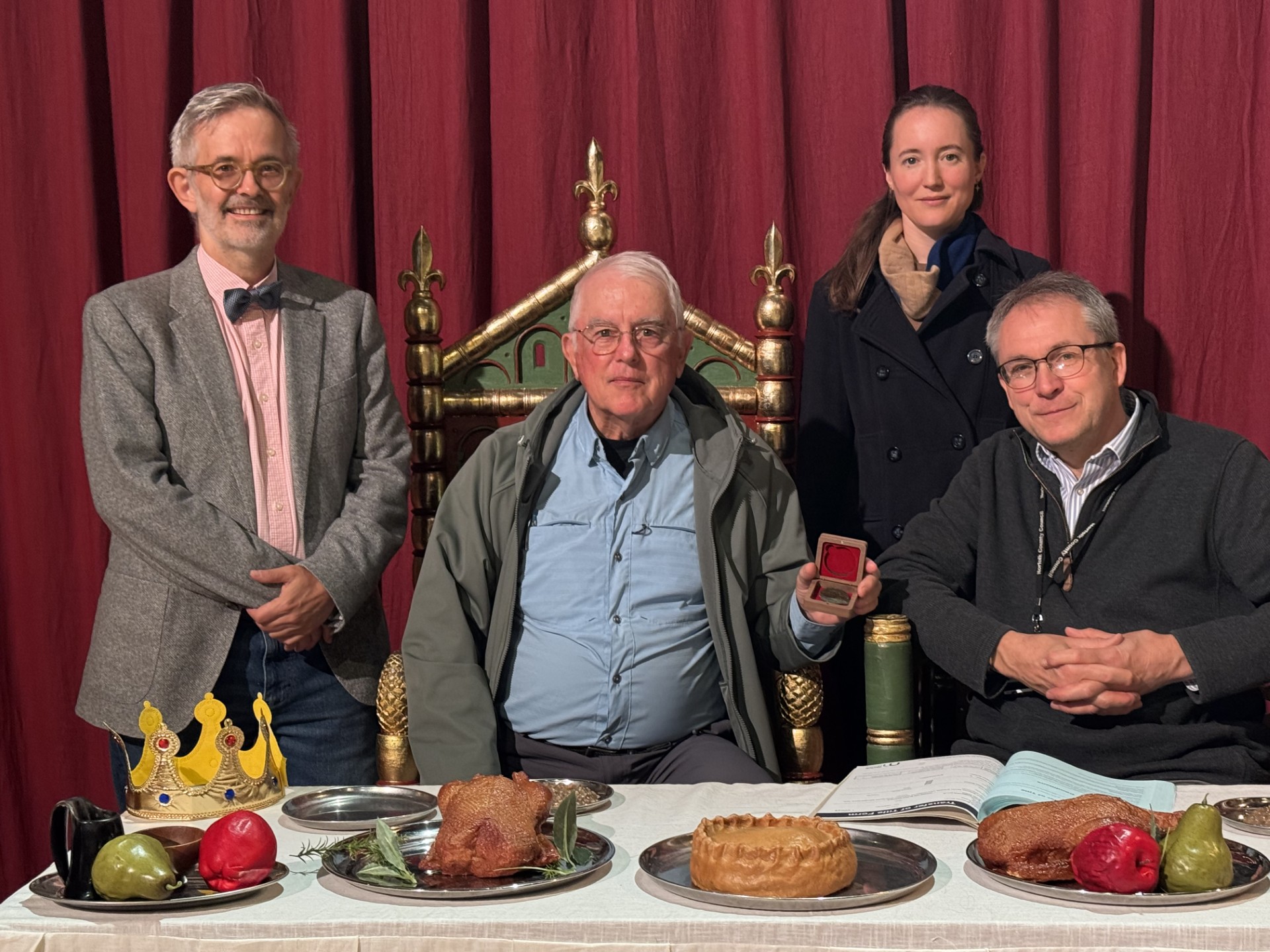
Stephen Wells discovered the brass item. Stephen lives in Alaska and has travelled to Britain over the last 10 years for metal detecting.
“I found the brass in a field and nobody knew what it was. I spoke to the landowner but he didn’t know. We went through the process of recording it and it turns out to be a fragment of a monumental brass. I took it home and contacted the Monumental Brass Society and they gave me some contacts, but it sat on my wall for a year. During my next trip over, I met Mark and told him about the brass find. He sent me lots of information and documents and helped to convince me that it should be in a museum. I’m glad I found a home for it, it’s your history, not mine, and you should have it on your wall.”
A monumental brass is a type of engraved metal funerary marker set into a stone tomb cover, depicting people using portraits, coats of arms and text. The brass found in Ingham shows a face and the top of a tonsured head, indicating a priest.
Mark Newstead is a parishoner in Ingham and arranged for the brass to be handed over to Tim at Norwich Castle.
“I’ve been aware of the importance of Ingham as a priory church for a while. The church nearly became a ruin in the early 1800s and was described as a blot on the landscape of the Diocese of Norwich. The chancel roof fell in and there was a real risk we would lose it.
History is one of the ways we can say to people that your parish church is still relevant to you, even if you just choose to come in during the week at a quiet time to yourself and not on Sundays. It’s still important to support these churches. In medieval times, they were the centre of village life and shaped the village identity and I want to use history to tell the stories so that people will become interested in connecting to their parish church again.”